

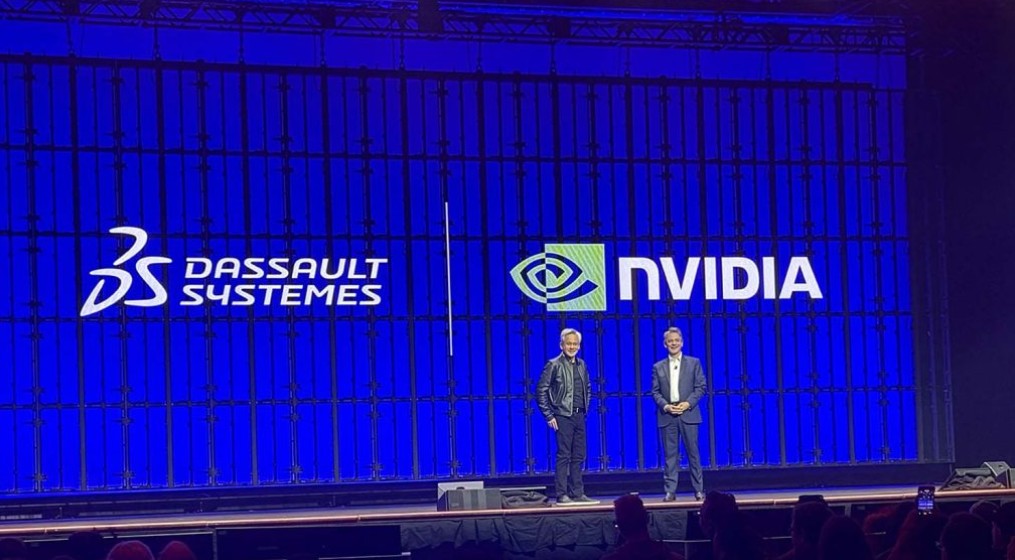
Nvidia’s chief executive, Jensen Huang, offered an optimistic view of artificial intelligence’s role in engineering and product design at the 2026 3DExperience World event, telling attendees that AI won’t shrink the number of designers and engineers but instead will expand the capacity of the profession. Huang said the rise of purpose-built AI assistants, or “agents,” will give every designer and engineer a digital companion to interpret intent and help use tools such as SolidWorks, Catia, and other key applications. Rather than eliminating jobs, these companions will multiply the number of virtual contributors working in design environments, accelerating workflows and amplifying human ingenuity, tells Develop 3D.
Huang argued that fears about AI replacing the human workforce misunderstand the dynamics at play. He said that as AI companions proliferate, the “number of virtual engineers” using design tools will expand exponentially even if the count of human engineers stays the same. This phenomenon, he suggested, will drive broader tool use and deeper engagement with design software. Designers, he said, should see AI as a partner that augments their abilities.
More specifically, Huang described AI systems that interpret what a designer intends to do, not just execute commands, as having the potential to give even less-experienced practitioners capabilities comparable to seasoned experts. These agents would relieve repetitive tasks, anticipate user needs, and translate creative goals into precise operations within complex software, effectively lowering barriers to advanced design work.
Huang’s remarks reflect a broader industry shift toward agentic AI and task-specific models that work alongside humans rather than in isolation, reshaping roles rather than displacing them. His stance aligns with a growing narrative in tech leadership that sees AI as a force multiplier for creativity and technical productivity, especially in fields such as CAD and engineering, where complex tools can slow innovation without smarter support.
