

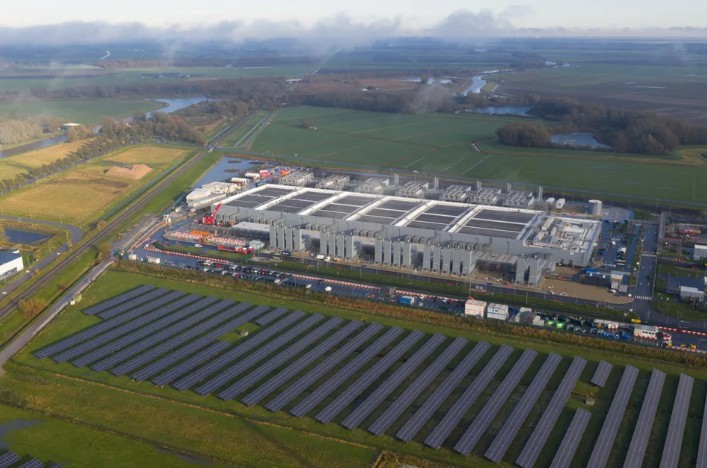
A recent article from Design News examines the growing strain artificial intelligence workloads are placing on global data center infrastructure. As AI models become larger and more computationally demanding, engineers are confronting limits in power consumption, thermal management, networking, and semiconductor performance that conventional data center designs were never built to handle.
The article explains that modern AI training clusters require enormous concentrations of GPUs operating simultaneously, often consuming tens or even hundreds of megawatts of electricity. This surge in demand is forcing companies to rethink nearly every layer of computing infrastructure. Traditional air-cooling systems are increasingly inadequate for dense AI racks, leading many operators to adopt liquid-cooling technologies capable of removing heat more efficiently from advanced processors. Immersion cooling and direct-to-chip cooling are becoming more prominent as thermal densities continue to rise.
The article highlights that electrical infrastructure has emerged as another major bottleneck. Utilities in several regions are struggling to provide enough grid capacity for hyperscale AI facilities, some of which now rival small cities in energy use. As a result, data center operators are exploring alternative energy strategies, including nuclear power, on-site generation, renewable integration, and advanced battery storage systems. Engineers are also redesigning power distribution systems to reduce transmission losses and improve operational efficiency.
The semiconductor industry is facing parallel pressures. AI accelerators require faster memory access, higher interconnect bandwidth, and more specialized architectures optimized for machine learning tasks. The article notes that companies across the hardware ecosystem are racing to improve chip packaging, photonic communication technologies, and networking systems to avoid performance bottlenecks inside massive AI clusters.
Beyond technical hurdles, the article frames the AI infrastructure boom as a broader industrial transformation. Data centers are evolving from relatively standardized computing facilities into highly specialized engineering projects demanding expertise in energy systems, fluid dynamics, materials science, and advanced manufacturing. The rapid expansion of AI is no longer just a software story. It is becoming a test of how quickly physical infrastructure and engineering innovation can adapt to the unprecedented computational appetite of modern artificial intelligence.
