

Advanced aerospace and defense systems operate under extreme conditions where conventional materials can fail. Hypersonic aircraft, rocket engines, and nuclear-powered submarines must endure intense heat, pressure, and mechanical stress. Engineers often rely on refractory alloys, a class of metals designed to maintain strength at very high temperatures. However, developing and manufacturing these materials has traditionally been slow and difficult. Researchers are now turning to artificial intelligence and additive manufacturing to accelerate that process, tells Tech Xplore.
Traditional alloy discovery depends heavily on trial-and-error experimentation. Scientists adjust chemical compositions, manufacture samples, and test their performance repeatedly. Because refractory alloys contain complex combinations of elements, exploring all possible variations can take many years. AI models help address this challenge by analyzing large materials datasets and predicting which alloy compositions are most likely to deliver the required properties, including heat resistance, mechanical strength, and printability.
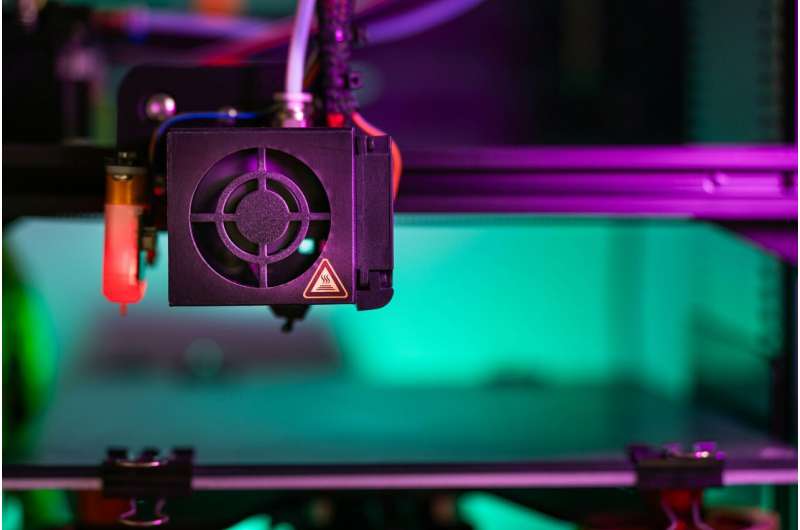
Once promising materials are identified, additive manufacturing allows researchers to fabricate complex components directly from digital designs. Three-dimensional printing techniques can build intricate internal structures that are difficult or impossible to produce through traditional casting or machining. These architected geometries improve performance by distributing stress more efficiently and reducing weight while maintaining structural integrity.
The integration of AI and additive manufacturing also shortens the design cycle. Machine-learning models guide researchers toward optimal alloy compositions and printing parameters, dramatically reducing the number of experiments required. This combination of computational design and rapid fabrication enables engineers to move from concept to tested prototype far more quickly than conventional materials development methods allow.
Despite these advances, challenges remain. Reliable datasets for training AI models are still limited, and scaling the production of newly discovered alloys for large industrial systems requires additional research. Nevertheless, the approach demonstrates a powerful new pathway for materials engineering.
By combining artificial intelligence with advanced manufacturing, researchers are creating materials capable of surviving some of the harshest environments ever encountered by machines. These developments could support the next generation of aerospace vehicles and defense systems while transforming the broader field of materials design.
