

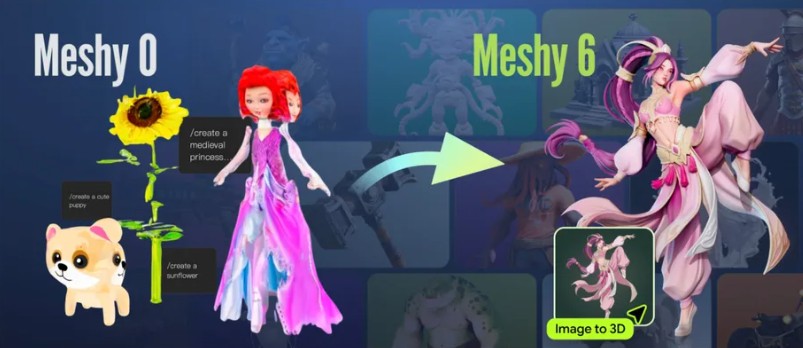
A new generation of AI-powered 3D modeling tools is rapidly changing the way designers, engineers, and creators develop digital objects. In a recent Design News article, Meshy.ai is presented as one of the emerging platforms capable of converting simple text prompts or images into editable 3D models within minutes, dramatically reducing the time traditionally required for modeling workflows.
The article describes how Meshy, originally aimed at creative hobbyists, has expanded into more professional and engineering-oriented applications. Demonstrations at Rapid + TCT 2026 showcased the platform generating detailed 3D assets from photographs and written descriptions, including personalized products such as custom keychains and character models. The underlying appeal lies in the speed of iteration. Instead of manually sculpting geometry inside conventional CAD or animation software, users can generate an initial model almost instantly and refine it afterward.
This shift reflects a broader movement toward generative design tools that simplify entry into 3D creation. Similar systems from Autodesk, Microsoft, and other AI developers are beginning to merge text-to-image and text-to-3D workflows into mainstream design software. These tools rely heavily on diffusion models and machine learning systems trained on massive datasets of shapes, images, and spatial relationships. Researchers have also demonstrated methods capable of generating full room-scale 3D environments directly from text descriptions, showing how rapidly the field is evolving.
The article suggests that AI-generated modeling could significantly affect industries such as gaming, product design, additive manufacturing, industrial visualization, and engineering simulation. Faster concept generation may shorten development cycles while enabling nonexperts to participate in workflows that previously required specialized technical skills. At the same time, human oversight remains essential because generated models often require refinement for precision, manufacturability, structural integrity, or production readiness.
Beyond productivity gains, the rise of text-to-3D systems signals a deeper shift in human–computer interaction. Designers increasingly communicate intent through natural language rather than manual geometric construction. As these systems improve, the boundary between imagination and digital fabrication continues to narrow, potentially reshaping the future of engineering design, visualization, and creative production.
