

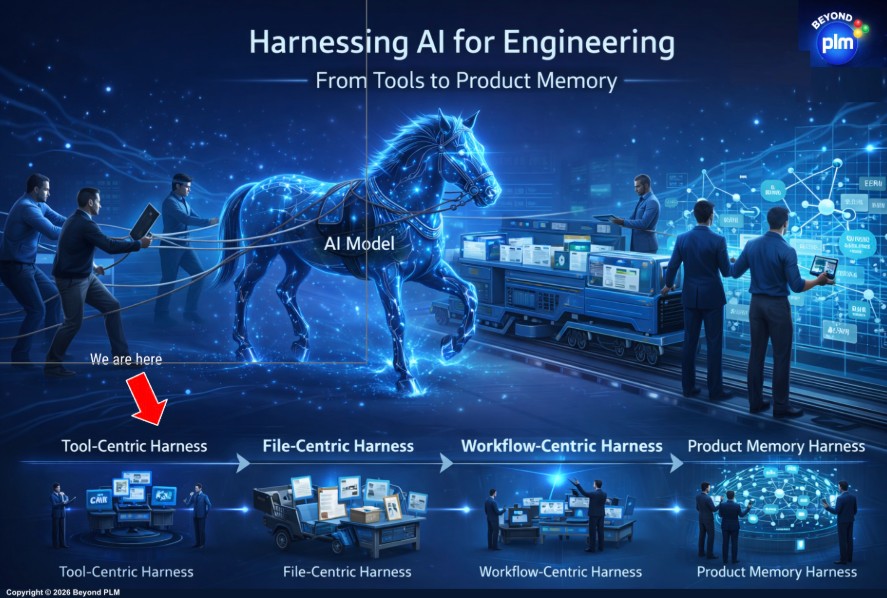
Artificial intelligence is rapidly advancing, but its effectiveness in engineering and manufacturing environments depends less on the sophistication of the model itself and more on the system that surrounds it. In a recent discussion on product lifecycle management (PLM), the concept of an “AI harness” emerges as a critical factor shaping whether AI becomes a practical engineering tool or remains a simple conversational assistant, tells Beyond PLM Blog.
An AI harness refers to the framework that connects a model to data, tools, workflows, and enterprise systems. It defines where the AI runs, what information it can access, and which actions it can perform. In practical terms, the harness determines whether AI can merely answer questions or actively participate in real engineering processes such as analyzing product data, managing workflows, or coordinating tasks across multiple systems.
Experiments comparing AI models demonstrate the importance of this surrounding architecture. The same model, using identical training and parameters, can perform dramatically differently depending on the harness environment in which it operates. Benchmarks cited in the discussion showed that a model achieved about 78% performance in one environment but only 42% in another. These differences highlight that system design often has a greater impact on real-world performance than improvements in the model itself.
The issue becomes especially significant in engineering and manufacturing, where decisions depend on complex relationships between product structures, design revisions, supply chains, and manufacturing constraints. Products evolve over time and exist across multiple software systems, including CAD platforms, bill-of-materials management, supplier databases, manufacturing planning tools, and service documentation. AI systems that only access isolated files cannot understand these relationships or support meaningful decision-making.
For AI to become genuinely useful in PLM, the harness must expose the connections that define the product itself. When AI can interact with structured product relationships rather than just individual documents, it can begin to reason about engineering decisions, lifecycle impacts, and manufacturing trade-offs.
The broader implication is that the future of AI in engineering may depend less on competing model capabilities and more on the design of intelligent platforms that integrate data, workflows, and product knowledge into a coherent system.
