

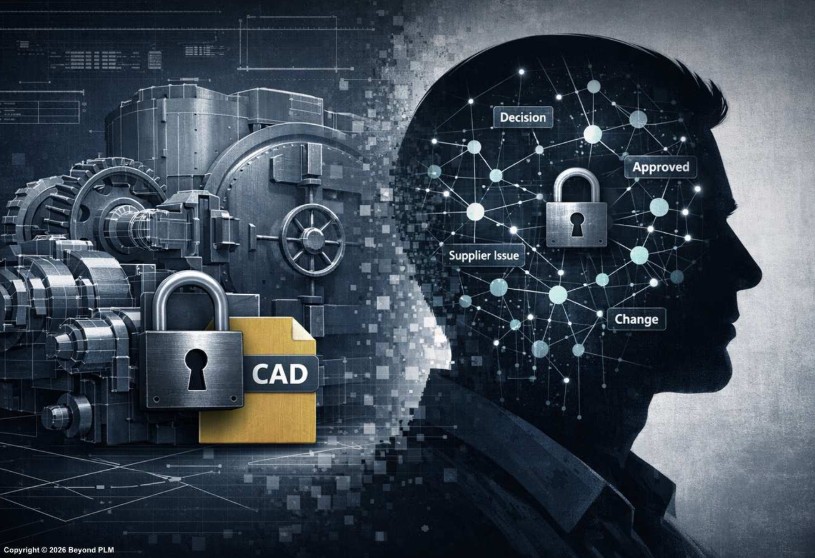
For decades, product lifecycle management systems have focused on storing structured outputs of engineering work, CAD files, bills of materials, and change histories. These systems created a form of lock-in by tying companies to proprietary formats and data schemas. But a new shift driven by artificial intelligence is moving that lock-in deeper, from files to the knowledge embedded in engineers themselves, tells Beyond PLM blog.
Much of what makes a design reliable does not exist in formal systems. Critical decisions, trade-offs, and lessons learned often live in the minds of experienced engineers rather than in documentation. When these individuals leave, organizations lose not just people but the reasoning behind past decisions, knowledge that traditional PLM tools were never designed to capture.
AI introduces a new layer that changes this boundary. Emerging enterprise systems are beginning to observe workflows in real time, capturing context around decisions, rejected alternatives, constraints, and problem-solving approaches. Over time, these systems build a persistent “memory” of how work is done, effectively modeling organizational thinking rather than just storing outputs.
This shift creates a new form of lock-in. In earlier generations, companies were tied to software because their data was difficult to migrate. In the AI era, the risk is that the accumulated intelligence, the patterns of decision-making learned by AI systems, cannot be easily transferred. Unlike files or databases, there is no straightforward way to export how an organization thinks and operates.
The implications are significant. If this AI-driven memory becomes deeply embedded within a vendor’s platform, switching systems could mean losing years of accumulated engineering insight. The cost is no longer a technical migration but a partial loss of institutional knowledge.
At the same time, this evolution signals opportunity. By capturing context and reasoning, AI could finally address one of engineering’s longest-standing challenges: preserving tacit knowledge. Yet it also demands a new set of questions for companies evaluating technology providers, shifting the focus from data ownership to control over organizational intelligence.
The transition marks a fundamental change in enterprise systems. The next generation of PLM will not just manage product data but encode the logic behind it, redefining both value and risk in engineering software.
