

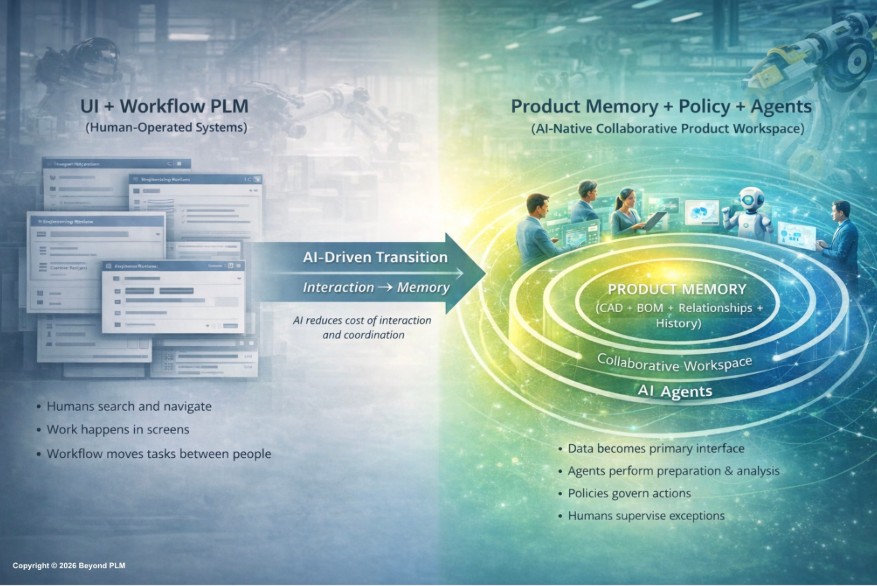
In a recent Beyond PLM blog post, the author tackles widespread claims about the so-called “SaaSpocalypse” and “PLMarmageddon” to argue that product lifecycle management isn’t dying because of AI. Instead, the article reframes industry disruption as a deeper shift in how PLM systems are built and what gives them value. The core idea isn’t that software disappears, but that the traditional way engineers interact with PLM will evolve as AI transforms automation and workflows.
Historically, PLM centered on human interaction: users accessed product data through screens and moved tasks through workflows. That model monetized the act of interaction and coordination. With AI agents emerging, this dynamic changes. The article makes the case that true PLM value lies not in interfaces or workflow routing but in the structured knowledge, often called product memory, embedded in PLM data such as CAD models, bills of material, design revisions, and change histories. This structured memory preserves engineering intent and product context, and it cannot be easily replicated by AI alone.
The blog suggests that legacy PLM becomes vulnerable when data access relies on user interfaces that adapt poorly to autonomous agents. In an AI-native future, agents supervised by policies and constraints act on data rather than people navigating screens. This requires a shift to architectures where data and automated actions take center stage, and humans supervise outcomes instead of performing every step manually.
Value within PLM will thus migrate from customizing user interfaces and managing tasks to ensuring product data integrity, governance, and cross-system connectivity. As AI agents drive preparation, analysis, and execution, a consistent product context becomes a differentiator. For vendors, this means prioritizing trusted product memory over superficial AI features. For buyers, evaluation shifts from seat counts to how well systems preserve product knowledge and support reliable automation.
In sum, the article reframes AI’s impact on PLM not as an end but as an architectural transformation, a move from systems humans operate to systems humans supervise, with structured data at the core.
