

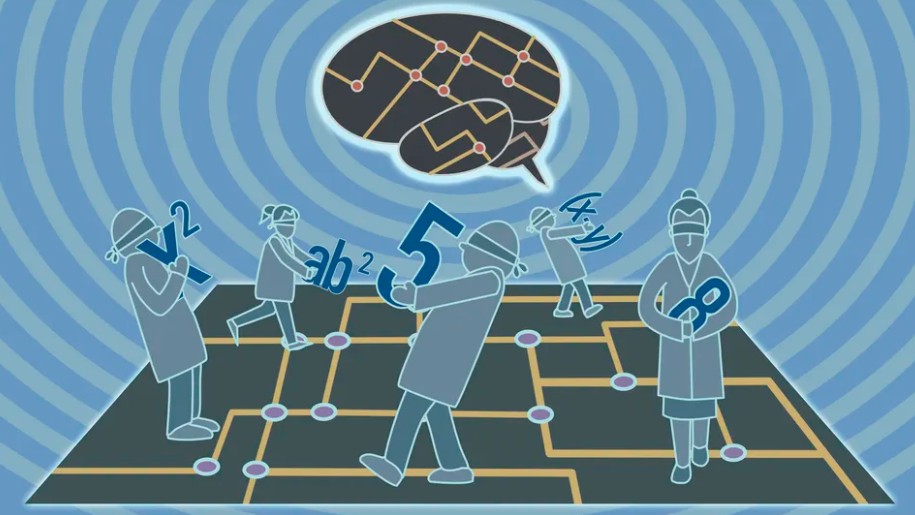
Artificial intelligence systems are now solving mathematical problems that stump humans, yet their solutions raise issues of credibility and interpretation among professional mathematicians, tells Live Science. The technology uses large language models trained on vast datasets of text to generate proofs and answers. In several high-profile cases, AI has found correct results for difficult problems by pattern recognition and reasoning across examples, reaching conclusions that would take human researchers far longer. The results have astonished the academic community but exposed a broader dilemma: the tools often present solutions confidently, even when they are flawed or incomplete, and they lack an intrinsic mechanism to justify their reasoning in a way that satisfies mathematical standards.
Mathematicians view rigorous proof as the gold standard: a sequence of logically irrefutable steps grounded in axioms and definitions. AI rarely produces this level of detail. Instead, it stitches together patterns it has seen to propose arguments that look plausible without guaranteeing correctness. This has led to cases of “proof by intimidation,” where the AI’s confident language masks uncertain reasoning. Researchers worry that, without interpretability and verification, AI results might mislead, especially when human experts cannot immediately check every claim. Efforts are underway to develop tools that integrate symbolic reasoning and formal verification so that AI can produce not just answers but checkable proofs.
This tension highlights a broader challenge for scientific AI: confidence and clarity do not guarantee truth. For AI to gain trust among professional mathematicians, researchers must tie its outputs to formal logical frameworks or create new standards for validating machine-generated insights. The field is moving quickly, but the process underlines that solving problems and proving solutions remain distinct goals in mathematics.
