

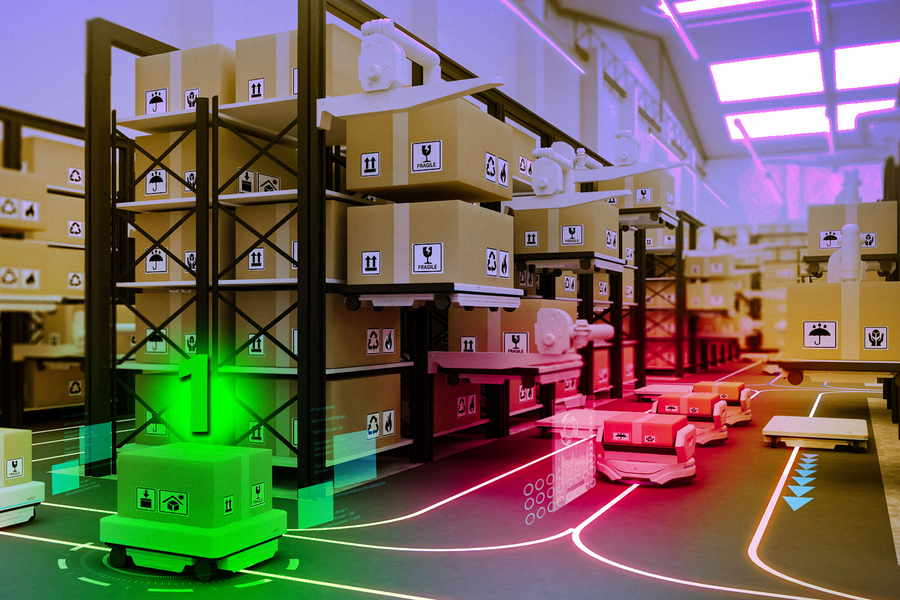
Inside modern e-commerce warehouses, hundreds of autonomous robots move simultaneously to retrieve and transport goods, creating a highly dynamic environment where even minor delays can cascade into major inefficiencies. A new system developed by MIT researchers, in collaboration with Symbotic, addresses this challenge by using artificial intelligence to coordinate robot traffic more effectively, tells MIT News.
The approach centers on a hybrid architecture that combines deep reinforcement learning with traditional planning algorithms. A neural network observes real-time warehouse conditions and determines which robots should be prioritized at any given moment. Instead of reacting to congestion after it occurs, the system anticipates bottlenecks and assigns right-of-way to robots most at risk of getting stuck, allowing traffic to flow more smoothly.
Once priorities are set, a fast and reliable planning algorithm translates these decisions into movement instructions for each robot. This combination ensures both adaptability and speed, enabling robots to respond effectively in constantly changing conditions where new tasks and routes are continuously introduced.
The system was trained using simulations modeled on real warehouse layouts, where it learned through trial and error to maximize throughput while minimizing conflicts. In these tests, it achieved about a 25% increase in throughput compared to conventional methods. Even modest improvements in efficiency can have a significant impact in large-scale operations, where delays can quickly escalate.
A key strength of the model is its ability to generalize. After training, it successfully adapted to different warehouse configurations, varying numbers of robots, and changing task demands without requiring extensive reprogramming. This flexibility makes it well-suited for real-world deployment in diverse logistics environments.
The research highlights a broader shift in industrial automation, where machine learning augments or replaces rule-based systems designed by human experts. By predicting interactions and optimizing movement in advance, AI-driven coordination can unlock higher efficiency and scalability.
As warehouses continue to expand and automate, such systems may become essential for maintaining smooth operations, ensuring that fleets of robots work together efficiently rather than competing for space.
