

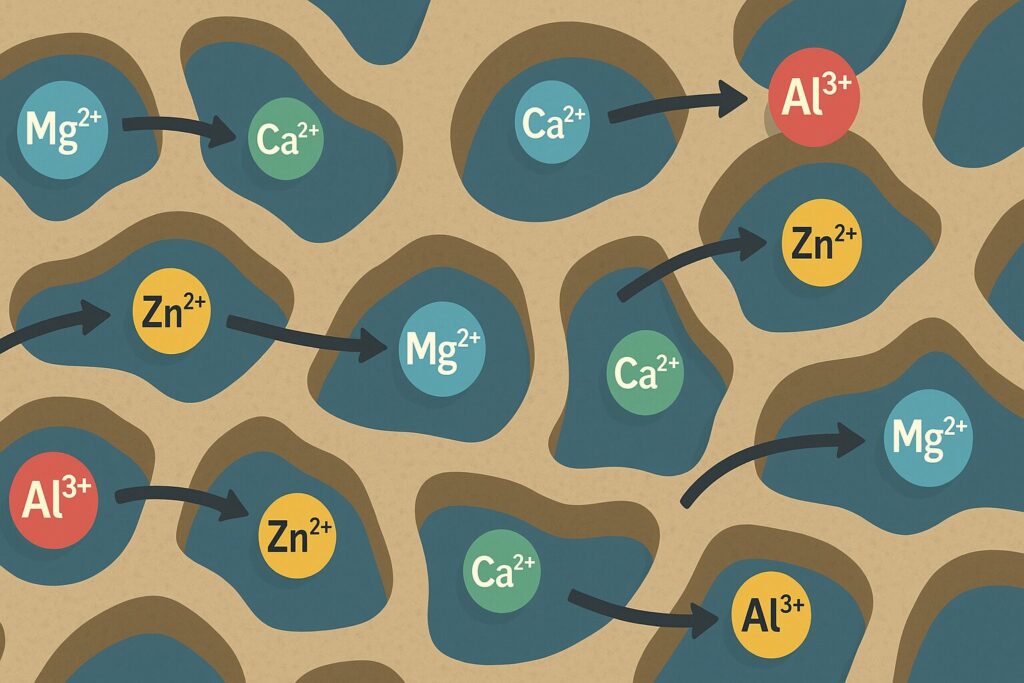
Researchers at the New Jersey Institute of Technology (NJIT) have harnessed generative AI and advanced screening methods to accelerate the discovery of multivalent-ion battery materials that could serve as sustainable alternatives to lithium-ion chemistry, according to this Tech Xplore article. These materials leverage abundant elements such as magnesium, calcium, aluminum, and zinc, aiming to minimize reliance on lithium, cobalt, and nickel—minerals associated with environmental and supply-chain concerns.
The AI-driven pipeline rapidly screened candidate compounds, predicting key performance metrics—such as conductivity, voltage, capacity, and structural stability—across large compositional spaces. This data-driven approach enabled efficient identification of porous oxide frameworks optimized for multivalent-ion intercalation, dramatically reducing traditional trial-and-error timelines from years to days or hours.
Key sustainable alternatives spotlighted are:
- Magnesium-ion and calcium-ion systems: These chemistries offer high charge density with vastly more abundant and lower-cost element sources.
- Aluminum-air and zinc-ion batteries: These technologies are inherently safer, recyclable, and compatible with aqueous electrolytes, yielding lower environmental footprints and manufacturing complexity.
How This Aligns with Sustainability Goals
- Resource efficiency: Using common elements reduces geopolitical risk, the ecological toll of mining, and ethical concerns tied to scarce materials.
- Scalable sustainability: Abundant raw materials suggest lower costs and easier recycling infrastructure.
- Accelerated innovation: AI dramatically shortens discovery cycles, enabling faster integration of greener battery materials into real-world applications.
This initiative marks a transformative step toward high-performance, low-impact energy storage. By enabling AI-driven discovery of multivalent-ion systems, it lays scientific groundwork for next-generation batteries that are safer, more affordable, and environmentally responsible, potentially reshaping grid-scale, transportation, and off-grid storage with true lithium-free alternatives.
