

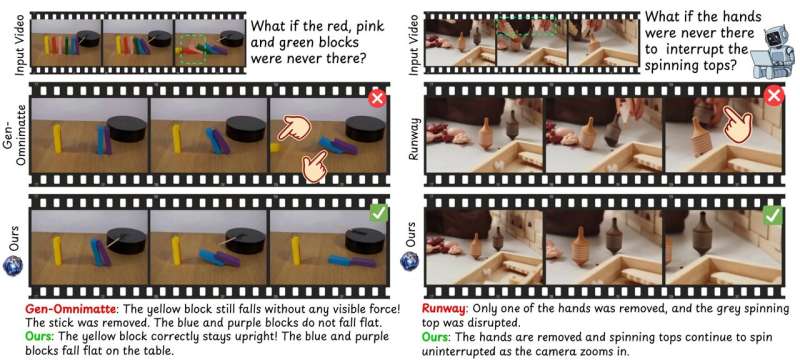
Video editing has long allowed creators to remove unwanted elements from footage, but doing so convincingly remains difficult when objects interact physically. A recent Tech Xplore article highlights a new artificial intelligence system called Video Object and Interaction Deletion (VOID), designed to overcome this limitation by ensuring edited scenes still obey the laws of physics.
Traditional editing tools can erase objects such as people or props, but they often fail to account for the physical relationships those objects have with their surroundings. This leads to unrealistic results, such as floating characters or objects behaving in ways that defy gravity and motion. The new AI system addresses this by modeling not just the visual appearance of a scene but also the underlying physical interactions between objects.
VOID works by identifying which parts of a scene are affected when an object is removed. It then reconstructs the motion and behavior of the remaining elements to maintain consistency. For instance, if a set of dominoes is partially removed, the system recalculates the chain reaction so that the remaining pieces behave logically, halting motion where necessary. Similarly, when removing hands spinning tops, the AI ensures the tops continue moving naturally rather than stopping abruptly.
The system is trained on simulated sequences that capture complex physical interactions, enabling it to generalize to real-world footage. This approach allows the model to predict how objects should move or respond once an interacting element is deleted, producing results that appear far more realistic than conventional methods.
This development points to a broader shift in AI-driven media tools. Rather than focusing solely on visual fidelity, researchers are increasingly embedding physical reasoning into models. By doing so, they aim to create systems that not only look convincing but also behave in ways consistent with real-world physics, improving trust and usability in professional editing workflows.
