

Water scarcity is a pressing concern. Over 2 billion people lack safe drinking water, and climate change is lengthening droughts and disrupting rainfall. The atmosphere, rich with moisture, could be a vast source if we can tap it efficiently. A recent analysis in the journal Joule explores how atmospheric water harvesting (AWH) might shift from niche experiments to scalable infrastructure, says Tech Xplore.
The article breaks down two main techniques. Condensation systems cool air to its dew point and collect water droplets. Sorption systems use materials that adsorb water vapor, then release it when heated. The authors develop thermodynamic models to estimate the minimum energy needed for each approach across different climates and heat conditions. That gives a lower bound on what real devices must aim for.
Condensation works well in humid conditions, but as air dries, energy costs climb. Cooling entire air volumes becomes inefficient. Below a relative humidity of about 30%, a large chunk of energy goes into cooling (sensible heat) instead of condensing water. In arid regions, frost buildup further hurts performance. Sorption is less sensitive to dryness, so it retains better efficiency in harsh climates. But it depends heavily on good heat sources for regeneration and precise internal design to manage heat and mass flows.
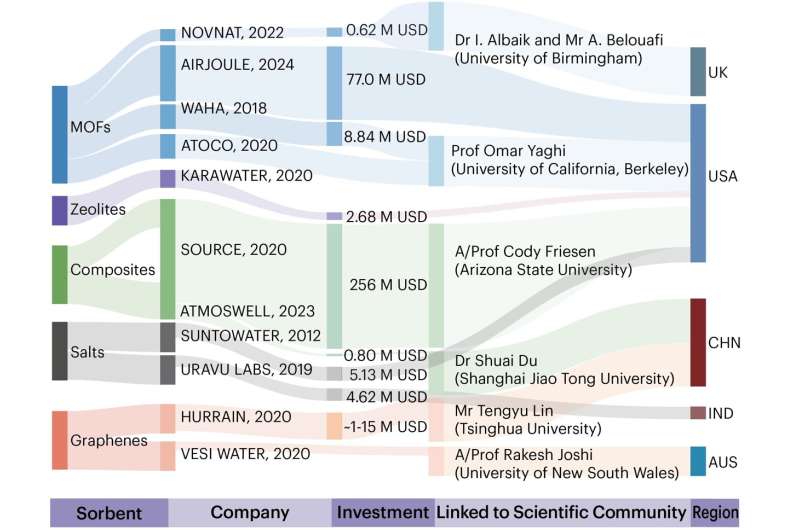
The authors surveyed over 100 companies working on AWH. Condensation devices dominate today, some claim >1,000 L/day output, but their actual energy use often sits well above theoretical limits, due to inefficiencies, heat losses, and mismatches in component design. Sorption systems are earlier in development; many produce under 10 L/day and lack standard energy accounting.
To bridge the lab and market, the authors propose a unified platform built around a heat pump. The cold side would feed condensation or boost adsorption; the hot side would support desorption. A four-way valve could alternate adsorption/regeneration beds for near-continuous operation. Integrating multistage heat pumps, recovering condensation heat, and tailoring design to climate and customer can push performance toward physical limits.
Economics and use cases are key. The analysis compares distributed AWH to water trucking, showing that as distance grows, AWH becomes more competitive. Ideal initial applications include emergency response, mobile supply, urban or rooftop systems, and supplements to desalination in coastal zones. The authors urge that success depends on designing for specific climates, customers, and energy sources, not scaling one model universally. If aligned properly, AWH could evolve into dependable infrastructure rather than laboratory curiosities.
