

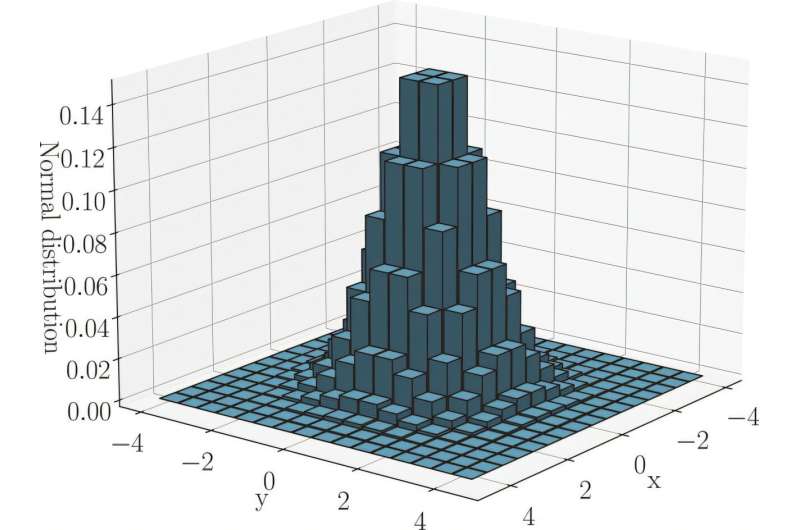
Scientists at the University of Hawai‘i at Mānoa have developed a mathematical algorithm that can identify the direction of a signal buried in noisy two-dimensional data, tells Tech Xplore. Traditional imaging and pattern recognition systems often struggle when noise or complex background information obscures underlying structure. The new method uses a mathematical comparison technique based on the Frobenius norm, a way of measuring differences between large grids of numbers, to assess how well rotated versions of a reference dataset align with measured data and determine the orientation that yields the smallest discrepancy. Simulations show this process can pinpoint the likely signal direction even when data contain significant noise.
The research team, led by physics undergraduate Jeffrey G. Yepez with guidance from Professor John G. Learned, first applied the algorithm to simulated neutrino data with the aim of locating signal sources such as nuclear reactors. Neutrinos are nearly invisible subatomic particles that can pass through matter with little interaction, making their directional detection a longstanding challenge in particle physics. By comparing rotated reference datasets to observed measurement distributions and minimizing the Frobenius norm, the algorithm isolates the most probable angle of origin for incoming signals.
Beyond particle physics, the technique could help with real-world imaging challenges in fields as diverse as astronomy, medical imaging, weather mapping, and machine learning. Any system that relies on identifying patterns or directional cues within two-dimensional distributions, from satellite data to biological images, could benefit from improved signal clarity. The algorithm is computationally efficient and scales well with large, high-resolution datasets, making it adaptable as detectors and sensors grow more powerful and data volumes expand.
This mathematical advance offers researchers a more robust foundation for extracting directional information from noisy environments, complementing existing statistical and signal-processing tools and opening new avenues for analysis across scientific and engineering domains.
