

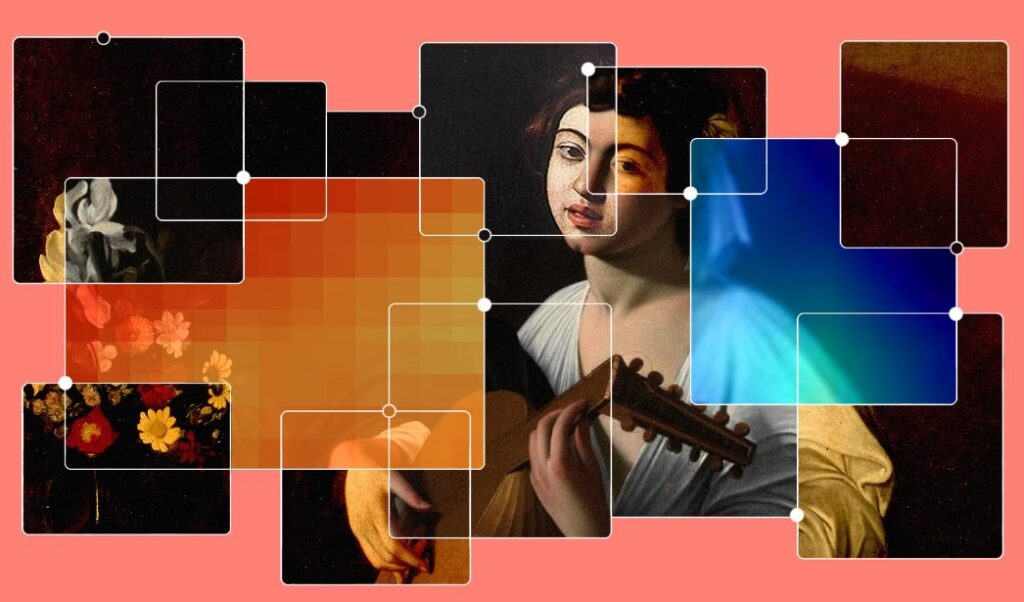
Artificial intelligence is increasingly being used to analyze and authenticate works of art, raising both excitement and skepticism among art historians and market experts. A prominent example involves the three known versions of The Lute Player, traditionally attributed to the Italian Baroque painter Caravaggio. While scholars generally consider the versions held by Russia’s Hermitage Museum and France’s Wildenstein Collection authentic, the one at Britain’s Badminton House has long been regarded as a copy. Yet an AI system developed by the Swiss firm Art Recognition suggested otherwise, estimating an 86% probability that the Badminton version could be genuine while indicating that the Wildenstein painting may be a copy, tells CNN Style.
Art Recognition’s technology relies on machine learning, deep neural networks, and computer vision. Its models are trained on two types of datasets: verified works by a specific artist and similar but inauthentic images, including copies, workshop pieces, and forgeries. By comparing patterns such as shapes, color palettes, textures, and compositional structures, the AI attempts to distinguish an artist’s authentic stylistic signature from imitations. The system analyzes paintings in small visual segments to detect subtle brushstroke patterns or compositional cues that may escape human observation.
The company has applied its methods to works associated with artists such as Rubens, Van Gogh, and Rembrandt. In some cases, its findings have supported existing scholarship, while in others they have challenged widely accepted attributions. Despite these results, many art historians remain cautious. Experts argue that authentication involves far more than surface style; it requires historical knowledge of materials, workshop practices, restoration history, and the broader context in which an artwork was produced.
Another concern is transparency. Because AI systems often provide conclusions without revealing exactly how they reached them, researchers cannot easily replicate or verify the analysis. Critics also note that different AI studies can produce conflicting outcomes.
Nevertheless, advocates believe AI can serve as a useful investigative tool. By flagging potential issues or identifying stylistic anomalies, algorithms may help experts reexamine disputed works, expose forgeries, and uncover overlooked paintings. In practice, however, AI is likely to complement rather than replace the judgment of human specialists in determining artistic authenticity.
