

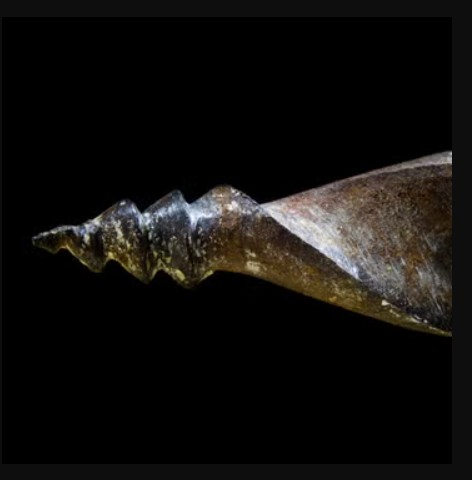
A small copper artifact discovered in Egypt more than a century ago is reshaping archaeologists’ understanding of early technological innovation. Researchers now believe the object represents the oldest known rotary metal drill, pushing the timeline of this tool’s development back by roughly 2,000 years. The discovery suggests that ancient Egyptian craftspeople mastered advanced drilling techniques much earlier than previously thought, tells Popular Mechanics.
The artifact was originally unearthed in the 1920s at the archaeological site of Badari in Upper Egypt, inside a grave known as Grave 3932. At the time, the object was cataloged simply as a small copper awl wrapped with a fragment of leather. Because it appeared ordinary, the tool remained largely overlooked for decades. Only recently did researchers from Newcastle University and the Academy of Fine Arts in Vienna reexamine the artifact in detail.
Using magnification and chemical analysis, the team discovered subtle features that pointed to a more sophisticated function. The tool shows wear patterns consistent with rotary drilling, including fine striations along the metal surface and a curved tip shaped by rotational motion. The remaining leather coils wrapped around the shaft were likely part of a bow-drill mechanism, in which a bowstring spins the drill rapidly back and forth to penetrate materials such as wood, stone, or beads.
The drill itself weighs only about 1.5 grams and measures just over two inches in length, yet its implications are significant. Evidence suggests it was made from a copper alloy containing arsenic, nickel, lead, and traces of silver. Such a composition would have produced a harder and more durable tool than ordinary copper, indicating that ancient metallurgists were deliberately experimenting with alloying techniques.
Previously known rotary drills dated to periods roughly two millennia later, and many depictions appear in Egyptian tomb art from around 1500 BCE. The Badari artifact shows that the technology already existed during the Predynastic era, before the first pharaohs ruled Egypt.
The finding highlights the often-overlooked role of everyday tools in shaping ancient civilizations. Rotary drills enabled artisans to produce intricate jewelry, furniture, and decorative objects, supporting the craftsmanship that later defined Egyptian culture and architecture.
