

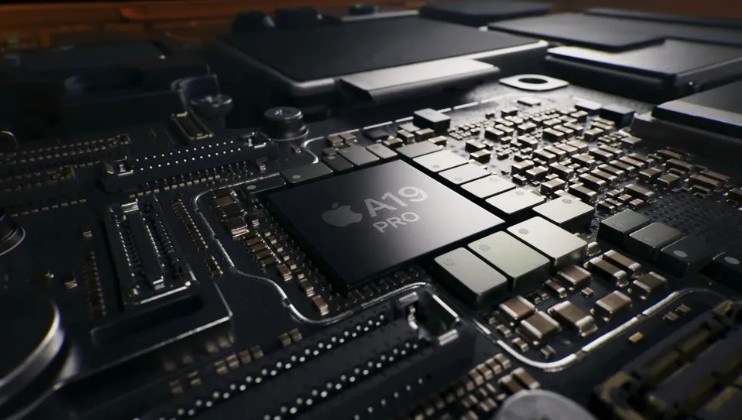
Apple has revealed its new A19 and A19 Pro processors alongside the latest iPhone lineup: the iPhone 17, iPhone Air, iPhone 17 Pro, and Pro Max, reports Tom’s Hardware.
A19 (Base Model)
The standard iPhone 17 runs on the A19 SoC, built on TSMC’s advanced N3P 3 nm process. It features a six-core CPU (two high-performance cores and four efficiency cores) and a five-core GPU with hardware-accelerated ray tracing, mesh shading, and MetalFX upscaling.
A19 Pro (Performance Tier)
Powering the iPhone Air, iPhone 17 Pro, and Pro Max, the A19 Pro retains the same six-core CPU but boosts GPU performance. The iPhone Air uses a five-core GPU variant, while the Pro models incorporate a full six-core GPU. Key upgrades include stronger branch prediction, better front-end bandwidth, and 50% larger last-level cache on the CPU side, plus neural accelerators built into each GPU core.
Together with a 16-core Neural Engine, these chips deliver notably faster on-device AI, gaming, and graphics performance. Apple claims sustained performance is up to 40% better than the previous generation.
Thermal Improvements
The iPhone 17 Pro and Pro Max models include a vapor chamber cooling system within a redesigned unibody aluminum frame. Apple states this setup cools 20 times more effectively than previous titanium designs, helping the A19 Pro maintain performance under load.
Networking Upgrades
Apple introduced two new in-house support chips as well. The N1 networking chip powers Wi-Fi 7, Bluetooth 6, and Thread connectivity, while the C1X modem doubles performance compared with the prior C1, though mmWave support remains limited to Qualcomm modems.
For hardware and systems engineers, the move to TSMC’s N3P 3 nm node signals better power efficiency per transistor and more design headroom. The expanded cache and stronger branch prediction highlight Apple’s priority on latency-sensitive workloads, which matters for engineers modeling code paths, compiler optimizations, and real-time control systems. The new vapor-chamber thermal design is also a practical case study in integrating advanced cooling in compact consumer electronics, something thermal engineers can analyze as a template for future portable devices.
