

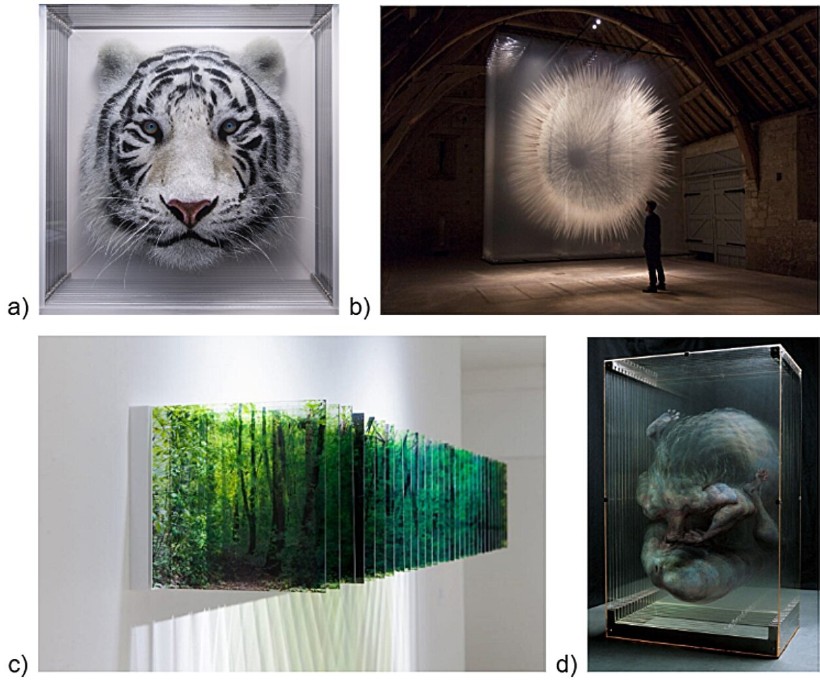
Artists have long created multilayer transparent works, i.e., paintings built on multiple sheets of Plexiglas or similar material, to give a sense of depth. A new research breakthrough, described in Royal Society Open Science, shows it’s possible to convert those layered paintings into full-parallax, full-color holograms while preserving their spatial relationships and artistic features, reports Tech Xplore.
The test subject is Taxonomy Test 1 by Yosman Botero, a painting composed of nine acrylic layers on Plexiglas. The research team photographed each translucent layer in high resolution, then reconstructed the layered scene in a 3D graphics environment so as to replicate the spatial arrangement.
To create the hologram, the team simulated a virtual camera sweeping through a 60-degree viewing arc, capturing thousands of images. Those images were then used in a CHIMERA holoprinter, which encodes the visual data onto a silver halide plate to produce a holographic reproduction. The final product is a full-color hologram that shows the painting from different angles (“parallax”) and retains depth cues.
Beyond aesthetic appeal, this technique offers conservation advantages. Transparent multilayer artworks are delicate: different layers can suffer different environmental damage (humidity, temperature, physical warping). Converting such works into holograms offers a way to reproduce them without risking the originals. It also saves space; holograms can be displayed without needing all the physical depth that layered originals require.
Museums and galleries could use the method to give visitors a more immersive experience (walking around or seeing paintings at different angles), while preserving fragile original works. The technology continues a long tradition of innovation in art, akin to how perspective changed painting during the Renaissance, but updated for optical and digital tools.
