

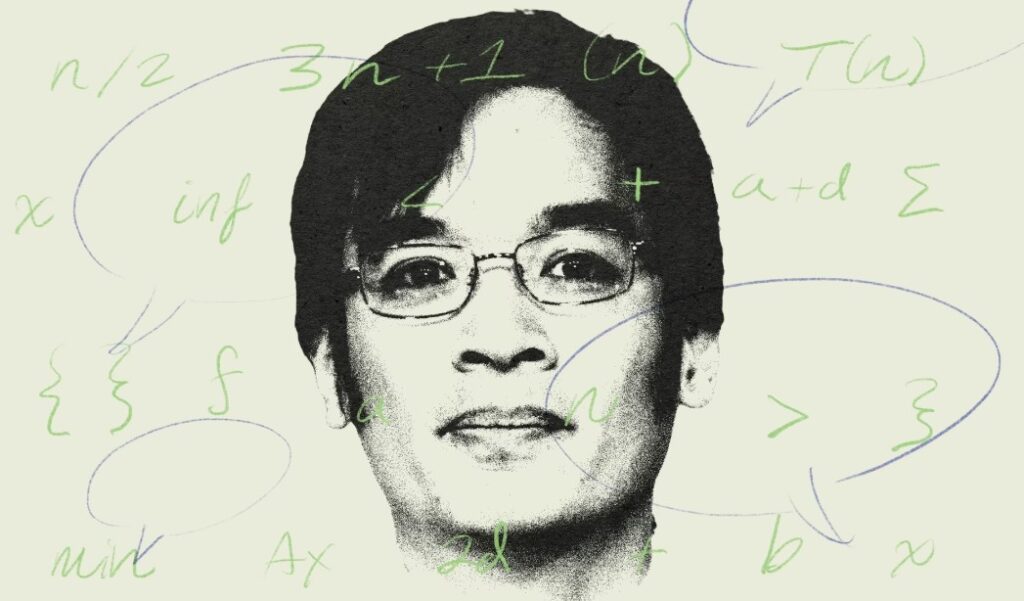
In The Atlantic article, Terence Tao, widely regarded as one of the world’s leading mathematicians, discusses the emerging role of generative AI in mathematical research and evaluates both its promise and its limitations. The conversation focuses on recent excitement surrounding AI systems that have reportedly solved some open problems from the large collection of questions proposed by Paul Erdős. Although these developments have drawn significant attention, Tao urges caution, describing many of the AI results as relatively modest achievements rather than major breakthroughs.
Tao notes that AI models have managed to solve several lesser-known problems within the long list of Erdős questions, often by applying established mathematical techniques at scale. While these successes demonstrate genuine progress, Tao characterizes them as “cheap wins,” explaining that many of the problems could likely have been solved by human mathematicians given sufficient time. The significance of the results, therefore, lies less in the difficulty of the problems themselves and more in the efficiency with which AI systems can explore large numbers of possibilities.
Despite these limitations, Tao sees real potential in AI as a collaborative tool for mathematicians. He compares current models to junior research partners capable of handling tedious computations and systematically testing many cases. By automating repetitive or labor-intensive steps, AI could allow mathematicians to focus on higher-level reasoning and conceptual insights. Tao suggests that such tools may transform mathematical practice by enabling researchers to analyze problems at a larger scale than traditional methods allow.
At the same time, Tao emphasizes that AI-generated solutions often lack the deeper insights that accompany human mathematical work. Human mathematicians typically develop intuition, intermediate results, and conceptual frameworks while solving problems. AI, by contrast, can sometimes jump directly to an answer without providing the intellectual pathway that helps advance the field.
Looking ahead, Tao believes AI could become a trusted research collaborator, especially if systems become better at signaling uncertainty and supporting interactive dialogue with human users. Rather than replacing mathematicians, AI is likely to reshape the discipline by introducing new methods of exploration and collaboration.
