

ASML’s latest lithography roadmap outlines the increasingly demanding future of semiconductor manufacturing, tracing the evolution from deep ultraviolet (DUV) systems to Low-NA EUV, High-NA EUV, and eventually Hyper-NA technologies. The Tom’s Hardware article (full article available to subscribers) examines how the Dutch chip-equipment giant plans to extend Moore’s Law despite rising technical complexity, soaring costs, and physical scaling limitations.
The roadmap shows that DUV lithography remains important even as EUV systems dominate leading-edge chip production. Many mature semiconductor nodes still rely on DUV tools because they remain cost-effective for automotive, industrial, and consumer electronics applications. Meanwhile, ASML continues refining Low-NA EUV systems to increase throughput and precision for advanced manufacturing. Upcoming systems such as the NXE:3800F and NXE:4200G are expected to deliver tighter overlay accuracy and higher wafer-per-hour productivity, enabling more efficient fabrication at smaller process nodes.
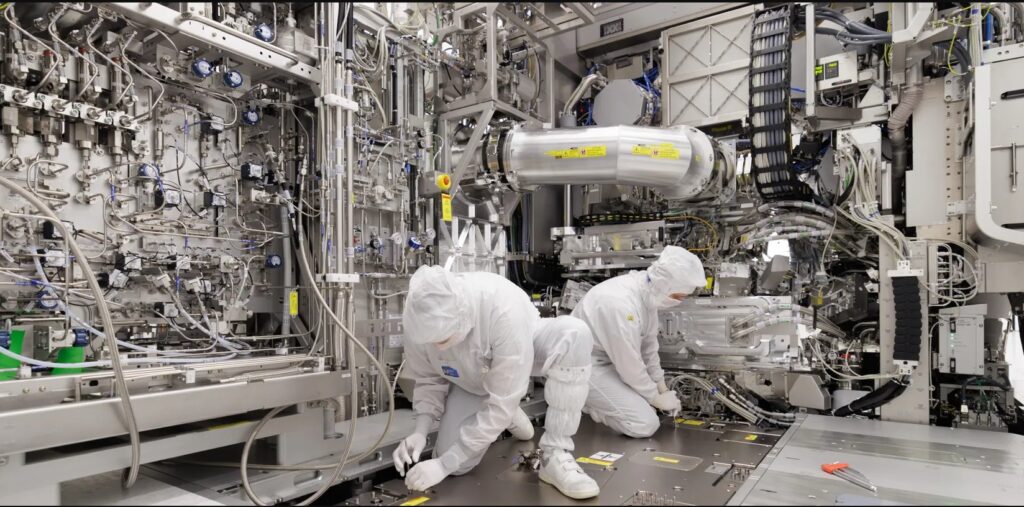
The article highlights High-NA EUV as the industry’s next major transition. These systems use a numerical aperture of 0.55, allowing finer resolution and reducing the need for complicated multi-patterning techniques. Intel has already installed ASML’s first commercial High-NA system, the Twinscan EXE:5200B, to support future 14A-class manufacturing. However, High-NA adoption remains expensive and technically challenging, with individual systems reportedly costing hundreds of millions of dollars while consuming enormous amounts of power.
Beyond High-NA, ASML is exploring Hyper-NA systems intended for the 2030s. These future tools would push transistor scaling even further, though they require major advances in optics, materials, resist chemistry, and power delivery. The company is also developing faster EUV light sources and modular platforms to improve productivity while controlling operational costs.
The article ultimately portrays lithography as one of the semiconductor industry’s defining bottlenecks. As AI accelerates demand for advanced chips, ASML’s roadmap demonstrates that sustaining progress in computing will depend not only on chip design but also on breakthroughs in the extraordinarily complex machinery used to manufacture silicon itself.
