

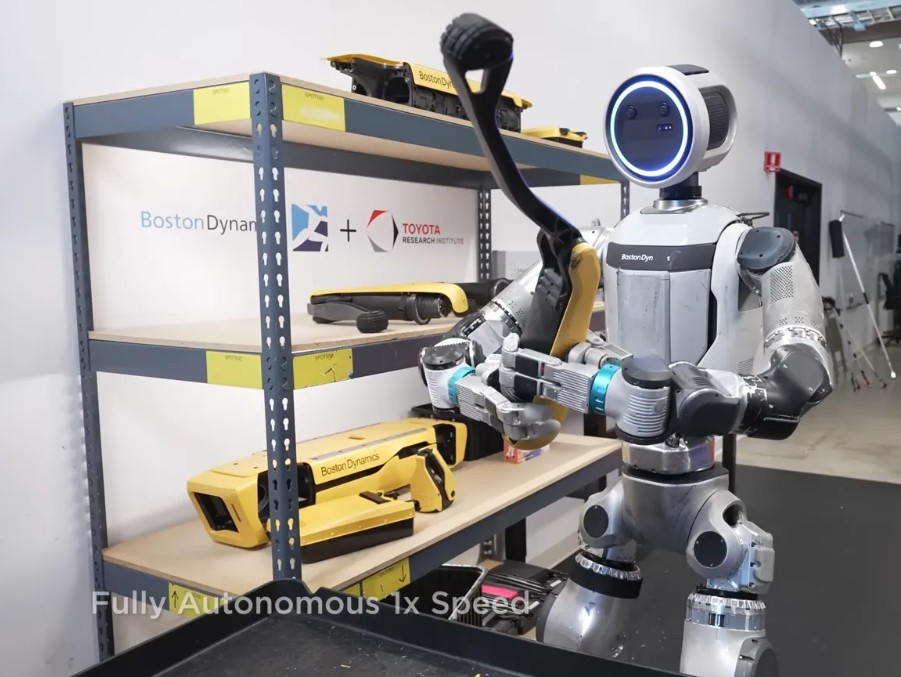
Boston Dynamics, in partnership with Toyota Research Institute, is moving Atlas humanoid into a new era of adaptability. The key is large behavior models (LBMs), i.e., neural networks trained on wide-ranging demonstration data rather than task-by-task coding, tells IEEE Spectrum.
Instead of building a robotics stack with planners, perception modules, and model-based controllers, the team now trains a single neural policy that directly imitates human demonstrations. Operators wear motion-tracking suits and teleoperate Atlas through tasks. The system learns from those input-output pairs, meaning anyone who can guide the robot can effectively “program” it, without writing code.
What sets it apart is scale and generality. By feeding the model data from many tasks and even multiple robot embodiments, it builds a foundational policy that adapts more naturally to new scenarios. The idea echoes what AI researchers are discovering elsewhere: models trained on broad, diverse datasets tend to generalize better than those trained narrowly.
But there’s more than training going on. The partnership relies on Toyota’s expertise in simulation and hardware validation, ensuring that these broad models behave safely and reliably when Atlas encounters unfamiliar environments or tasks.
Boston Dynamics’ vice president of robotics research, Scott Kuindersma, calls this moment “one of the most exciting points in the history of robotics,” and it is clear why. This approach could make humanoid robotics more accessible to hands-on users and designers, not just elite roboticists. The road isn’t smooth yet; the heavy lifting of collecting high-quality demo data is an obstacle, but this blend of teleoperation and large-scale imitation learning points toward robots that can learn more like humans do and adapt more like we expect them to.
