

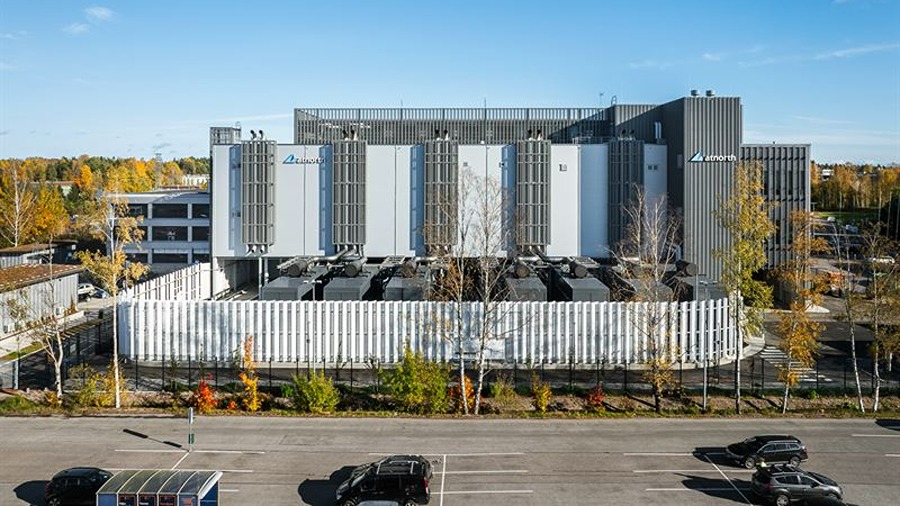
HELSINKI, Finland, Mar 26, 2026 – atNorth announced that its heat reuse partnership with Kesko Corporation went live in Nov’2025, using waste heat from its FIN02 data center in Espoo to heat a nearby Kesko store. The system supplies nearly all of the store’s heating demand, reducing reliance on district heating and lowering emissions for both companies. The project reflects atNorth’s push to apply circular economy practices in its operations.
Kesko targets a 58.8% reduction in Scope 1 and Scope 2 emissions, a major source of which results from heating its buildings. The FIN02 heat reuse system addresses this demand. It is expected to reduce about 200 tons of CO₂ from district heating, or about 0.9% of Kesko’s district heating emissions.
“Reducing emissions from the heating of our properties is a key priority within our sustainability strategy,” said Antti Kokkonen, director of energy at Kesko. “Through this collaboration with atNorth, we are able to significantly cut emissions at one of our stores while demonstrating how innovative partnerships can accelerate the transition to lower-carbon operations.”
The initiative shows how data centers can support local energy systems. By capturing and reusing surplus heat, the project improves the energy efficiency of the FIN02 facility and contributes to Finland’s economy.
“As demand for AI-ready digital infrastructure continues to grow, it is essential that data centers scale responsibly,” said Erling Gudmundsson, COO of atNorth. “This project demonstrates how data centers can become active contributors to local energy systems. By recycling excess heat, we can reduce our client’s environmental footprint while supporting our partners’ sustainability goals and delivering tangible benefits to the surrounding community.”
atNorth is expanding its data center footprint across the Nordics, with FIN02 facility supporting its regional infrastructure plans. The company is developing partnerships to capture and reuse excess heat.
The Kesko project builds on heat reuse collaborations across atNorth’s portfolio, including a community greenhouse in Akureyri, Iceland, and partnerships with waste-to-energy company Vestforbrænding in Denmark and Stockholm Exergi in Sweden to supply for the local district heating networks. These projects link data center operations with local energy demand.
Source: atNorth
About atNorth

atNorth, based in Reykjavík, Iceland, operates data centers across the Nordic region, providing high-density colocation, build-to-suit facilities, and connectivity services for enterprises, hyperscalers, and high-performance computing (HPC) users. The company serves industries such as AI, cloud computing, infrastructure, and research. Founded in 2009, it has operated for about 16 years. atNorth runs eight data centers in Iceland, Sweden, and Finland, with additional sites under construction in Kouvola, Finland, and Ølgod, Denmark, and a planned facility in Sollefteå, Sweden. Its operations use renewable energy and emphasize energy efficiency and circular economy principles. The company designs its facilities for scalability, power efficiency, and flexible deployment to meet long-term infrastructure needs across the region.
About Kesko Corporation
Kesko Corporation is a Finnish retail and trading company operating in grocery, building and technical, and car trade sectors. It supplies food, home goods, construction materials, and vehicles, along with logistics and retail services. The company serves consumers, construction professionals, technical contractors, and automotive customers across Northern Europe. It operates about 1,800 stores in Finland, Sweden, Norway, and the Baltic states. Kesko was founded in 1940 through the merger of regional wholesalers. Its headquarters are in Helsinki, Finland. The company manages retail chains, supports independent store entrepreneurs, and runs wholesale and business supply operations. Its model combines consumer retail and B-to-B distribution.
