

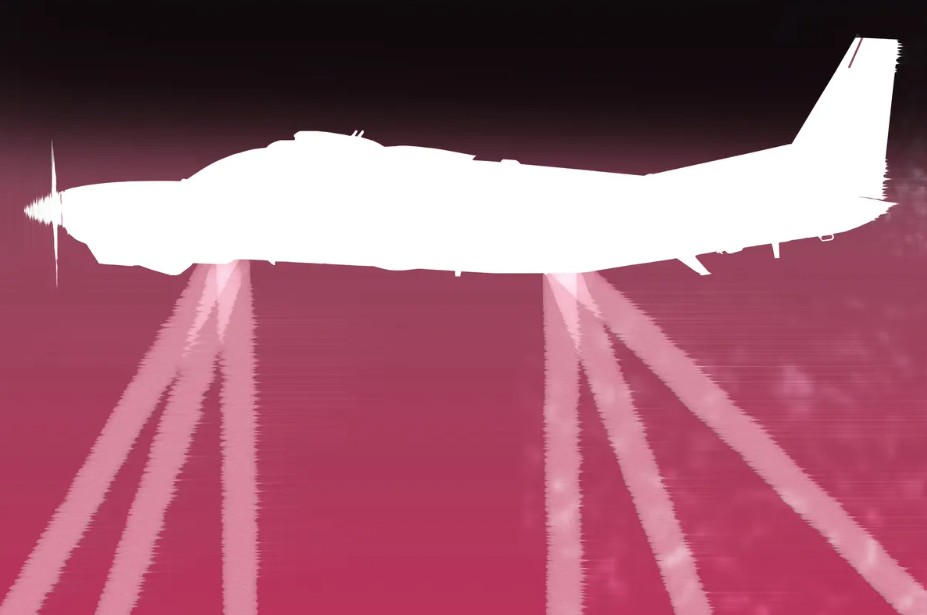
Researchers have demonstrated the first wireless power transmission from a moving airplane to receivers on the ground, a milestone for long-distance energy beaming, tells IEEE Spectrum. During a November test over Pennsylvania, a Cessna turboprop flying at about 5,000 meters and facing strong crosswinds beamed near-infrared energy downward while airborne. The test marked the first instance of active power beaming from a moving platform to ground receivers, accomplished by the Virginia startup Overview Energy.
Overview’s goal is to build on this flight test to develop space-based solar power systems. The idea is to place satellites in geosynchronous orbit that collect uninterrupted solar energy and convert it into infrared waves beamed back to Earth. Because infrared energy can be received by existing utility-scale solar panels, receivers are already in place to convert the transmitted energy.
Space-based solar power has long hovered between concept and serious research. Caltech’s space solar power team previously demonstrated microwave transmission in orbit, and the U.S. Defense Advanced Research Projects Agency set a terrestrial power-beaming record in 2025 by sending 800 watts over 8.6 kilometers using a laser beam. But until Overview’s experiment, no one had beamed power from a moving vehicle with all functional components working together.
Overview’s approach uses near-infrared waves instead of microwaves. Company leaders argue that microwaves occupy much of the radio spectrum already allocated to services such as cellular communications, making large-scale use problematic. Infrared beaming also maintains low power density for safety while enabling energy reception with existing solar technology.
The demonstration transferred only a small amount of energy, but it showed the feasibility of key elements of the system Overview plans to scale. Future steps include a prototype low Earth orbit demonstrator and, later, geosynchronous satellites capable of beaming megawatts to gigawatts of power by the 2030s. Challenges remain, from launch costs and orbital hazards to achieving efficient large-scale transmission, but the test opens a path toward wireless power from space.
