

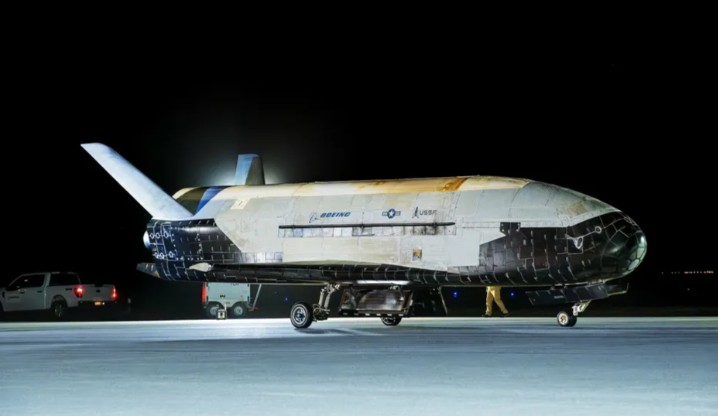
The U.S. military’s secretive X-37 B spaceplane—set for its eighth mission in August 2025—is carrying a groundbreaking quantum inertial sensor designed to enable precise navigation without GPS. Developed under contract to Vector Atomic for the Defense Innovation Unit, it’s the first time such advanced quantum inertial navigation technology will be tested operationally in orbit, says LiveScience.com.
This sensor harnesses atom interferometry, a quantum measurement technique where atoms cooled to near absolute zero behave like waves. Split into a superposition of two paths via finely tuned lasers, these atomic waves then recombine, producing interference patterns. These patterns encode minute shifts caused by acceleration or rotation, allowing detection of motion with unparalleled sensitivity.
In contrast to traditional inertial systems, which rely on mechanical gyroscopes and are prone to drift, quantum sensors exploit the intrinsic consistency of atoms. This dramatically reduces bias and drift over time, offering long-duration, high-accuracy navigation without external signals.
The Space Force emphasizes that this mission significantly boosts navigational resilience, especially in GPS-denied environments such as deep space, cislunar zones, or contested domains prone to signal jamming. The sensor promises robust positioning even when GPS is unavailable or compromised.
Built to be compact, durable, and suitable for long-duration spaceflight, the sensor moves atom interferometry from laboratory science to practical aerospace applications.
The X-37B’s quantum inertial sensor could pave the way for GPS-free navigation systems, offering unmatched accuracy and autonomy for spacecraft in the growing challenges of space and beyond.
