

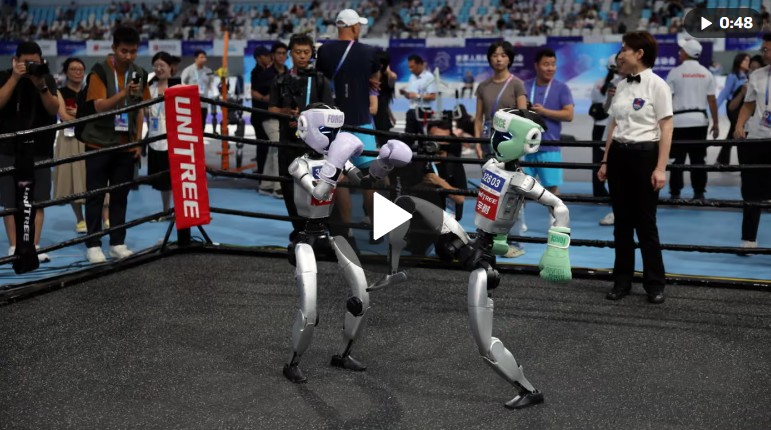
At the inaugural World Humanoid Robot Games in Beijing’s National Speed Skating Oval, more than 500 AI-controlled humanoid robots from 280 teams across 16 countries competed in events like kickboxing, football, dancing, athletics, and even medicine sorting and cleaning—an electrifying showcase of China’s investment in embodied AI.
This interesting article on The Guardian tells that advances were evident in the robots’ ability to execute complex routines: delivering kicks and jabs, dancing in unison, scoring goals, and completing tasks that require a degree of coordination and control. Companies such as UBTech and Unitree Robotics stood out, pushing forward applications in manufacturing and elder care with cost-effective hardware.
However, the limitations were equally pronounced. Robots frequently stumbled, toppled, or malfunctioned—one lost its head mid-race, another collapsed and needed to be carried off like an injured athlete. Balance control, battery endurance, and real-world robustness remain major technical hurdles. Experts note that basic tasks such as navigating cluttered environments, handling delicate objects, or safely interacting with humans in home settings are still far beyond current capabilities.
While the games thrilled audiences with moments of athleticism and theatrical flair, they also underlined how hyperspecialized movements in controlled settings don’t yet translate into consistent performance in unstructured, real-world environments. However, these failures are valuable—each malfunction provides critical data for refining embodied AI and robotics control systems.
The competition illustrated both the promise and the gap: humanoid robots are becoming increasingly dynamic and engaging, yet practical deployment—especially in daily life or industrial settings—remains constrained by mechanical complexity, environmental unpredictability, and safety concerns.
