

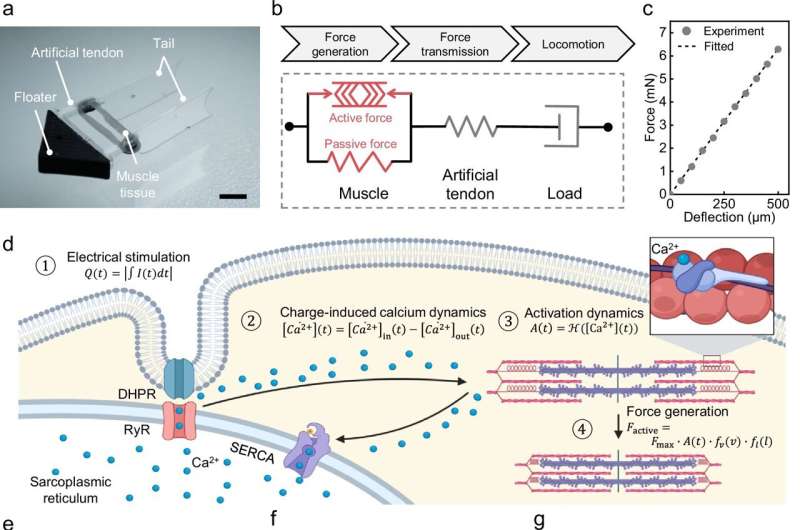
A new biohybrid robot powered by lab-grown muscle tissue demonstrates a novel approach to overcoming one of the biggest limitations in soft robotics: weak actuation. Reported by Tech Xplore, the research introduces a system where engineered muscle tissues strengthen themselves through continuous mechanical interaction, eliminating the need for complex external stimulation.
The breakthrough comes from researchers at the National University of Singapore, who designed a setup in which two strips of cultured muscle are linked together. When one contracts, it stretches the other, creating a reciprocal cycle of contraction and resistance. This arrangement mimics natural exercise, allowing the tissues to “train” themselves and gradually increase strength and endurance over time.
This self-reinforcing mechanism was applied to a small swimming robot known as OstraBot. Powered entirely by these enhanced muscles, the robot achieved speeds significantly higher than previous biohybrid systems, reaching nearly half a meter per minute. The result highlights the growing viability of biological actuators for real-world robotic applications, particularly where flexibility and efficiency are essential.
The innovation addresses a persistent challenge in the field. Traditional lab-grown muscles often lack the strength required for sustained motion, limiting their usefulness. By embedding a built-in training loop, the researchers have created a system that improves with operation, offering a pathway to more capable and resilient biohybrid machines.
Beyond performance, the approach points to broader possibilities. Muscle-driven robots are soft, adaptable, and inherently energy-efficient, making them suitable for applications such as medical devices, environmental monitoring, and biodegradable systems. Their ability to integrate living tissue with engineered structures also opens new directions for robotics design.
This work reflects a shift toward machines that incorporate biological intelligence at the material level. Rather than relying solely on mechanical or electronic control, these systems harness the natural adaptability of living tissues, suggesting a future where robots evolve and strengthen through use.
