

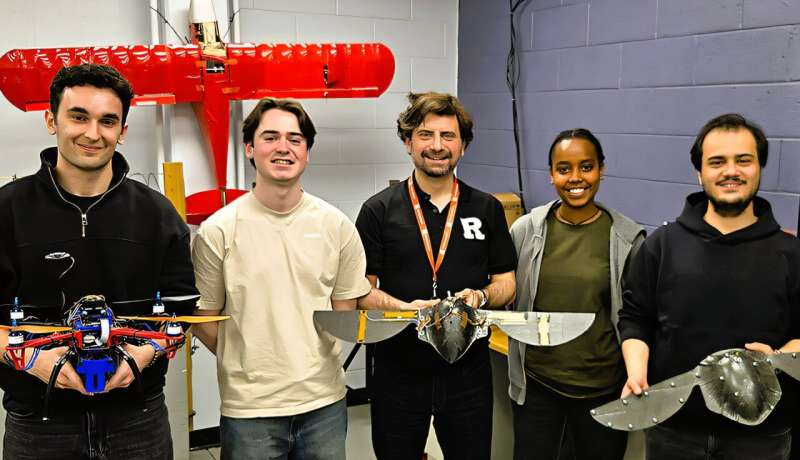
Engineers are rethinking drone design by turning to nature, developing bird-like robots that move with the flexibility and responsiveness of real wings. Unlike conventional drones that rely on rigid propellers and motors, these new systems use flapping, morphing wings powered by electrically responsive materials. The result is a class of “ornithopters” that more closely replicate how birds navigate turbulent air and tight spaces, tells Tech Xplore.
At the center of this innovation is the use of piezoelectric materials, which deform when voltage is applied. Instead of relying on gears, linkages, or motors, these materials are embedded directly into composite wings. When activated, the wings flex, twist, and flap in a coordinated way, enabling smoother and more adaptive flight. This solid-state approach reduces mechanical complexity while improving responsiveness to environmental changes such as wind gusts.
Traditional drones struggle in cluttered or unpredictable environments because their rigid structures limit maneuverability. Bird-like robots, by contrast, can continuously adjust wing shape and motion, offering finer control. This makes them particularly suited for applications such as search and rescue, infrastructure inspection, and urban navigation, where obstacles and dynamic conditions demand agility.
To support development, researchers have also created integrated simulation models that capture the full physics of flapping flight. These models link aerodynamics, structural motion, electrical behavior, and control systems into a single framework, allowing engineers to test and refine designs virtually before building prototypes. This reduces development time and accelerates progress toward practical deployment.
While bird-inspired drones are not entirely new, most existing versions still depend on conventional mechanical actuation. The shift toward simpler, material-driven designs marks a departure from attempts to mimic bones and muscles with complex mechanisms. Instead, researchers are focusing on lightweight, flexible systems that achieve similar outcomes with fewer components.
The work signals a broader transition in robotics, where adaptability and material intelligence are becoming as important as raw power. By embedding motion directly into structures, these bird-like robots could expand where and how drones operate, bringing them closer to the efficiency and versatility seen in nature.
