

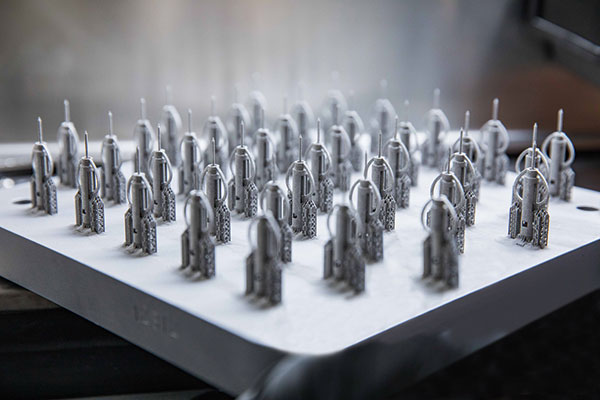
Hybrid manufacturing is emerging as a practical strategy for optimizing production by combining additive and subtractive processes into a unified workflow. The Digital Engineering 24/7 article explains that this approach allows manufacturers to leverage the design flexibility of additive manufacturing alongside the precision and surface quality of traditional machining.
Rather than treating these methods as competing technologies, hybrid manufacturing integrates them to address specific production challenges. Additive techniques can create complex geometries and near-net-shape parts, reducing material waste and enabling designs that would be difficult or impossible with conventional methods. Subtractive processes then refine these parts, ensuring tight tolerances, improved surface finishes, and compliance with engineering requirements.
This combination leads to more efficient production workflows. By minimizing material usage and reducing the number of separate manufacturing steps, hybrid systems can shorten production cycles and lower costs. They also allow manufacturers to respond more quickly to design changes, making them well-suited for low-volume, high-value parts or customized components.
The article also highlights the role of digital tools in enabling hybrid manufacturing. Simulation, data integration, and advanced planning systems help coordinate multiple processes and optimize production parameters. These tools allow engineers to evaluate trade-offs between speed, cost, and quality before committing to physical production, improving overall decision-making.
Despite its advantages, hybrid manufacturing introduces complexity. Integrating different machines, workflows, and software systems requires careful planning and expertise. Ensuring compatibility between additive and subtractive processes, as well as maintaining consistent quality across both, remains a key challenge.
The article frames hybrid manufacturing as a step toward more flexible and intelligent production systems. By combining the strengths of multiple processes, manufacturers can optimize performance while adapting to evolving demands, positioning hybrid approaches as a critical component of modern industrial strategy.
