

Researchers are challenging the long-held belief that brain-inspired neuromorphic hardware is good only for pattern recognition or sensory tasks by showing that it can also solve complex mathematical problems. A study published in Nature Machine Intelligence demonstrates that neuromorphic systems, inspired by the structure and operation of biological brains, can execute the finite element method (FEM), a cornerstone numerical technique for solving differential equations in engineering and physics. These equations describe how physical phenomena such as fluid flow, heat transfer, and structural stress change over space and time. Traditionally, solving such problems requires large clusters of conventional processors and enormous energy use, but neuromorphic architectures may offer a new path, tells IEEE Spectrum.
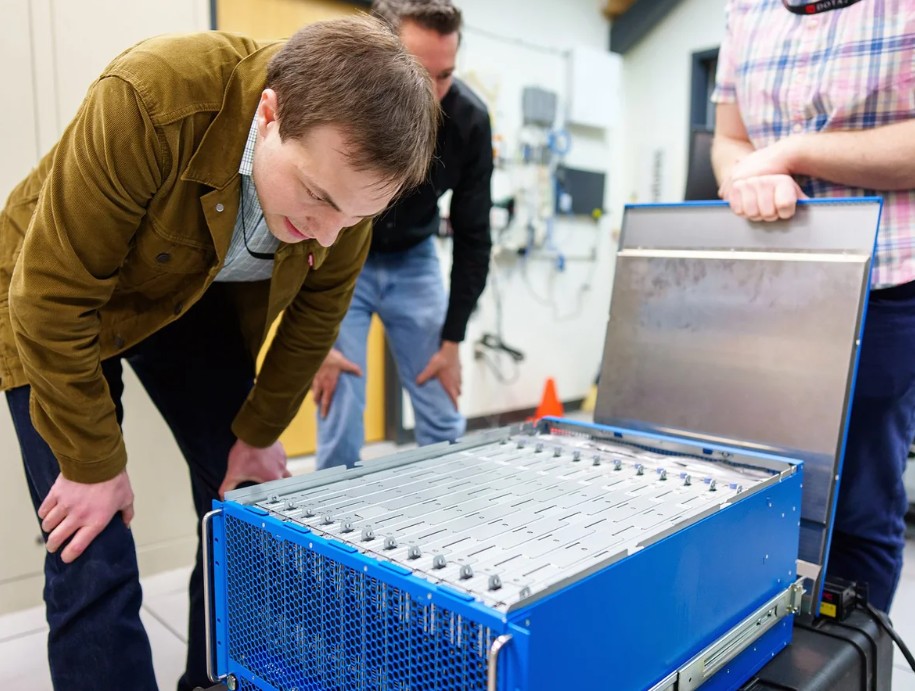
Neuromorphic computing draws inspiration from the brain’s neural networks, where sparse, asynchronous spikes of activity propagate between interconnected artificial neurons rather than moving large blocks of data through a central processing unit and separate memory. Systems like Intel’s Loihi 2 implement billions of spiking neurons on hardware that mimics this brainlike communication, naturally lending itself to parallel processing. In the recent work, scientists translated the mathematical structure of the FEM into a neuromorphic algorithm and implemented it on Loihi 2, showing that such hardware can directly solve partial differential equations, not by approximating outcomes with neural-network surrogates, but by executing the underlying numerical method in a spiking framework.
Early results suggest neuromorphic platforms could offer energy advantages over conventional architectures, especially when scaling to large systems. While conventional computing has been optimized over decades for mathematical simulations, neuromorphic systems remain in early stages of development. The research implies that next-generation computing hardware might transcend current roles in AI accelerators and sensory processing to become viable tools for scientific and engineering computation, all with the energy efficiency that makes brain-inspired computing attractive in the first place.
