

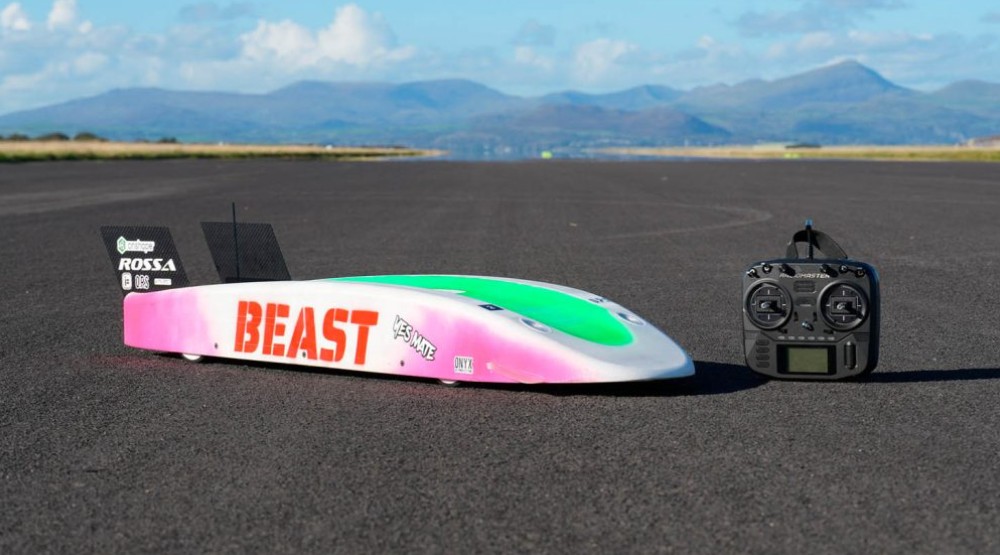
Engineer and hobbyist Stephen Wallis set out to build the fastest remote-control car ever, combining practical simulation with creative design to smash existing speed records. In September 2025, he pushed the Guinness World Record to 234.71 miles per hour, 15 mph faster than the previous best, using a vehicle he called the Beast. Wallis started with a blank slate, exploiting open rules in the Radio Operated Scale Speed Association’s speed trials to rethink conventional remote-control design, tells Develop 3D.
His early concept began with a modified quadcopter drone he dubbed the Crone, using horizontal wheels on the drone motor shafts. The Crone reached 129 mph in tests, proving that blending flight control sensors with ground-vehicle mechanics could yield unexpected stability and speed. With data from that prototype, Wallis built the larger, more powerful Beast. He relied heavily on simulation, spreadsheet-based physics calculations, CFD tools, and rapid iterations to balance aerodynamics, weight distribution, and stability over uneven surfaces such as the Llanbedr Airfield runway, where trials took place.
Early runs exposed weaknesses. Initial designs used torque vectoring for steering, but reliability issues and components burning out, including speed controllers, forced a redesign that incorporated mechanical steering and more robust electronics. 3D-printed parts played a key role in prototyping and final assembly, from the aerodynamic bodywork to suspension elements.
At ROSSA events, the Beast steadily improved. Round 1 hit 196 mph, and after tweaks, including a higher-voltage battery system, Round 2 passed 213 mph. Ultimately, the car’s 234.71 mph run cemented its place in the record books, though Wallis notes the record has since been surpassed. That hasn’t slowed him; he’s now pursuing “Project 250,” aiming for speeds on par with high-performance hypercars.
The article highlights how hands-on engineering, simulation tools, and iterative testing can push hobbyist projects into world-record territory, blending real-world physics with creative problem-solving.
