

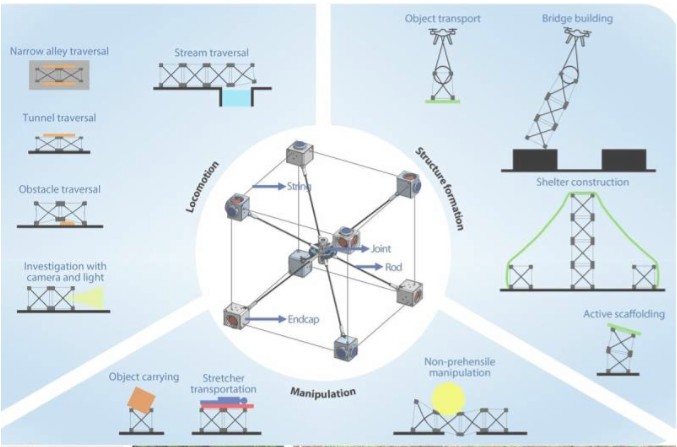
Dartmouth researchers have developed innovative modular robots composed of cube-shaped blocks combining rigid rods with stretchable, tension-adjustable strings. These versatile units can reconfigure to perform a range of outdoor tasks—navigating complex environments, building emergency structures, and even conducting rescues, reports Tech Xplore.
In field tests around the Dartmouth campus, the robots demonstrated impressive adaptability: they crawled under fallen logs, compressed to pass through narrow gaps, and assembled frameworks for makeshift shelters. Inspired by ants, the modules formed bridges spanning small streams, enabling objects to be transported across gaps. For instance, when a board was laid across a chain of blocks, it acted as a stretcher capable of carrying a human-sized dummy—hinting at significant future potential, even though current prototypes cannot yet support human weight.
Each module integrates a battery-powered 3D-printed core and a Wi-Fi unit, enabling untethered, wireless control. With a single charge, a module can “walk” for over three hours, offering a blend of robustness, lightweight portability, and rapid deployability. The researchers envision these robots as vital assets in disaster relief, where they could be air-dropped and quickly assembled into bridges or shelters.
Enhancing Functionality: How Modular Robots Could Be Made More Powerful
- Specialized Modules: Introducing modules with built-in sensors, cameras, or manipulators could enable environmental perception, diagnostics, or object handling—expanding tasks from relocation to complex interventions.
- Heterogeneous Combinations: Mixing lightweight foragers with heavy-duty support modules could improve load-bearing capacity, mobility, and adaptability across varying terrain.
- Autonomous Reconfiguration: Embedding AI and onboard planning logic would allow robots to self-assess the environment and adapt their structure autonomously—forming bridges, shelters, or tools on demand.
- Improved Structural Strength: Reinforcing joints or adopting stronger materials would enhance load tolerance—paving the way from carrying dummies to potentially supporting human loads.
- Energy and Communication Efficiency: Incorporating solar charging, energy-harvesting modules, or mesh networking could extend operational duration and resilience, particularly in remote or disaster-stricken areas.
Dartmouth’s modular robots showcase remarkable adaptability for outdoor applications—from navigation to emergency construction. By integrating specialized modules, autonomous planning, improved materials, and enhanced energy systems, these systems can evolve into highly functional tools engineered for real-world resilience and utility.
