

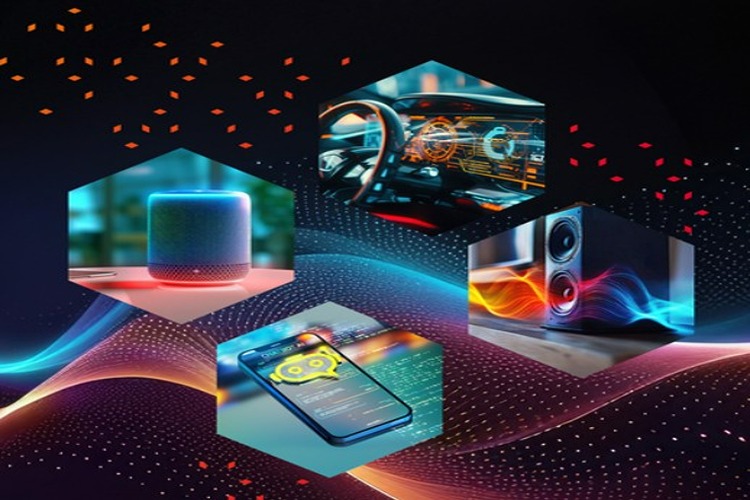
SAN JOSE, CA, Jan 28, 2026 – Cadence has introduced the Cadence Tensilica HiFi iQ DSP IP, the sixth generation of its HiFi DSP family. Built on a new architecture, it targets voice AI and immersive audio workloads in system-on-chip (SoC) designs. The HiFi iQ DSP addresses performance and energy efficiency requirements across home entertainment, automotive infotainment and smartphones. Compared with the Tensilica HiFi 5s DSP, HiFi iQ delivers 2x compute performance and 8x higher AI throughput. Cadence reports more than 25% energy savings for most workloads and over 40% higher performance on many audio codecs.
“With the increased growth of AI across virtually every facet of the industry, audio and language have become critical interfaces for users,” said Anshel Sag, VP and principal analyst, Moor Insights and Strategy. “The AI performance and energy savings with Cadence’s new flagship Tensilica HiFi iQ DSP position it to enable future AI-enhanced applications and offload processing from other IPs.”
Compute demands continue to rise as audio and voice applications grow more complex. Immersive audio codecs, higher sampling rates, object-based rendering, natural language processing (NLP), and automotive road-noise cancellation (RNC) increase processing requirements. These workloads require expanded AI/ML capability and advanced audio signal processing while meeting low-latency and low-power constraints.
Cadence drew on more than 20 years of audio development and instruction-set optimization to design the new DSP architecture. The Tensilica HiFi iQ DSP is built for AI-enhanced audio workloads and improves on the Tensilica HiFi 5s DSP while addressing current audio processing requirements. Key features include:
- 2x the raw compute performance and 8x higher AI performance for compute-intensive audio standards
- More than 25% energy savings across multiple workloads for on-device AI processing
- Enhanced auto-vectorization to simplify programming and reduce development time
- Integrated support for FP8, BF16 and other formats to run voice AI models
Cadence reports more than 40% higher codec performance from the Tensilica HiFi iQ DSP compared with the Tensilica HiFi 5s DSP. The added compute capacity supports audio codecs such as Dolby MS12, Eclipsa Audio, Opus HD and Audio Vivid. The DSP also supports keyword spotting (KWS), active noise cancellation (ANC), beamforming and automatic speech recognition (ASR) on a single architecture. These capabilities allow NLP workloads to run alongside audio tasks. Multi-stream and multi-channel playback supports 3D spatial audio rendering, including listening zones and sound bubbles.
“With recent advancements in LLMs, SLMs, energy-efficient SoCs and on-device AI, voice input is poised to become the new keyboard. To enable seamless interaction with the latest physical AI applications, SoC providers need energy-efficient and easily programmable IP capable of running SLMs on-device while performing voice and audio processing seamlessly,” said Boyd Phelps, senior vice president and general manager of the Silicon Solutions Group at Cadence. “As the market leader in DSPs for audio, voice, speech and AI applications with billions of Tensilica HiFi DSPs in a wide array of embedded products, SoC and system vendors rely on Cadence to continue to push the envelope for performance and energy efficiency.”
The Tensilica HiFi iQ DSP supports execution of small and large language models, enabling voice AI workloads to run on the DSP. When paired with Cadence’s Neo NPUs, the architecture delivers higher performance while maintaining energy efficiency.
The Tensilica HiFi iQ DSP supports AI model execution using Cadence NeuroWeave Software Development Kit (SDK), TensorFlow Lite for Micro (TFLM), LiteRT and ExecuTorch. It also benefits from OEM ecosystem that provides software libraries, compilers, codec packages and development frameworks.
Availability
The Tensilica HiFi iQ DSP will be available to selected customers and partners in the first quarter of 2026, with general availability expected the following quarter. The DSP is targeted for ISO 26262 certification. Cadence also plans future support for cache-coherent multicore configurations.
Source: Cadence
About Cadence

Cadence Design Systems, Inc. is a U.S.-based technology firm that develops electronic design automation (EDA) tools, hardware, and IP for designing integrated circuits and electronic systems. Formed in 1988 through the merger of SDA Systems and ECAD, the company is headquartered in San Jose, CA. Cadence provides software and solutions for designing SoCs, PCBs, and complete electronic systems used in the semiconductor, automotive, aerospace and defense, telecommunications, and consumer electronics industries. Its tools support both digital and analog design workflows. As of 2024, Cadence employed about 12,000 people globally. The company’s technology supports the design, verification, and optimization of complex electronics across various industries.
