

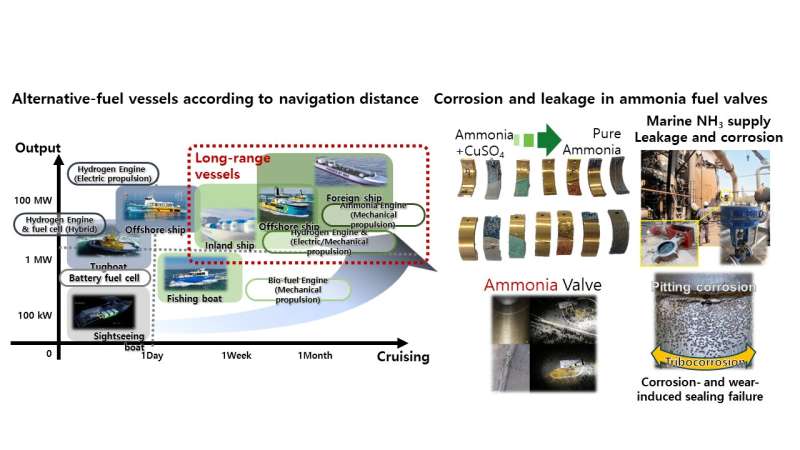
A research team from the Korea Institute of Materials Science (KIMS) has developed a new carbon-based surface coating designed to protect marine metals from tribocorrosion, a damaging process caused by the combined effects of friction, wear, and chemical corrosion. The breakthrough addresses a growing challenge for the maritime industry as it explores ammonia as a low-carbon fuel for next-generation ships, tells Tech Xplore.
Tribocorrosion occurs when mechanical wear and electrochemical corrosion interact simultaneously, accelerating the degradation of metal surfaces far more quickly than either process alone. In marine environments, this phenomenon can severely damage critical components such as engines, valves, pumps, and bearings, especially when they are exposed to aggressive chemical environments such as ammonia fuel systems.
Traditional marine metals, including stainless steel 440C, are particularly vulnerable when exposed to ammonia because its strong alkalinity can break down protective oxide layers on the metal surface. This leads to localized corrosion, rapid wear, and eventual structural failure during long-term operation. Such durability concerns have become a major obstacle for the commercialization of ammonia-powered ships.
To address this problem, the KIMS research team developed a highly corrosion-resistant carbon coating known as ta-C:Hx. The coating acts as a protective barrier that suppresses both chemical corrosion and mechanical wear across a wide temperature range, from cryogenic conditions to moderate temperatures encountered in marine propulsion systems.
Laboratory testing demonstrated significant improvements. The new coating reduced corrosion current density from about 48 microamps per square centimeter in untreated materials to approximately 4 microamps per square centimeter, representing a 92% reduction. Tribocorrosion wear rates also dropped dramatically, falling by roughly 99% compared with conventional stainless steel surfaces.
The technology could play an important role in enabling durable components for ammonia-based marine engines and fuel systems. As the shipping industry searches for carbon-free propulsion solutions, materials capable of resisting harsh chemical and mechanical conditions will be essential. The newly developed coating offers a promising pathway for extending component lifetimes and accelerating the adoption of environmentally friendly maritime fuels.
