

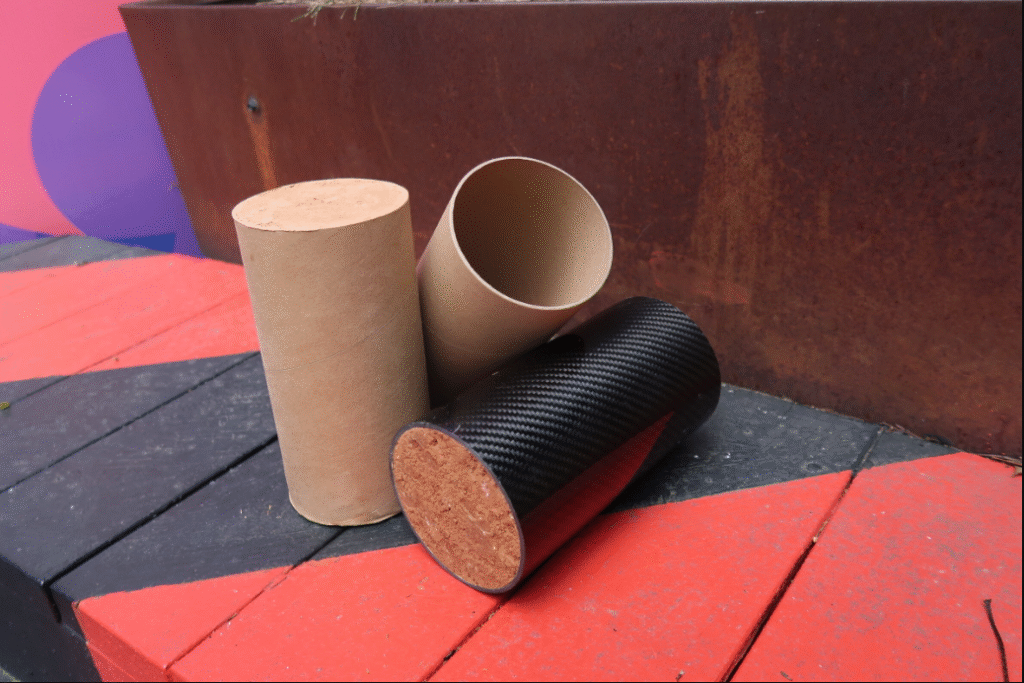
Engineers at RMIT University in Australia have developed a novel building material that combines cardboard, soil, and water to create structural elements with about one-quarter of concrete’s carbon footprint. The innovation, called cardboard-confined rammed earth, requires no cement, is recyclable, and costs less than a third of conventional concrete options, tells Tech Xplore.
The idea builds on traditional rammed earth construction, which compacts soil (often with cement additives) into forms to create sturdy walls. The RMIT team replaced rigid formwork with cardboard tubes, which both shape and confine the earth while it cures. Because cardboard is lightweight, more sustainable, and often a waste product, this method also reduces the volume of discarded cardboard heading to landfills.
Practically, this approach enables on-site fabrication. Builders can haul cardboard tubes rather than bulky concrete or brick, then compact local soil and water inside them. In remote or resource-constrained areas, where soil is abundant, such a system could significantly reduce transport costs, simplify logistics, and lower upfront material demands. The thermal mass of the Earth gives interior temperature stability, minimizing reliance on active cooling systems in hot climates.
The research also explores how the thickness of cardboard affects the mechanical strength of the structure. In parallel, the team has tested combining rammed earth with carbon fiber reinforcement, yielding strength comparable to high-performance concrete in laboratory settings.
While the concept is still early stage, the authors are actively seeking industry partnerships to refine and scale it. If successful, cardboard-confined rammed earth could shift how we think about sustainable construction, i.e., prioritizing local materials, lower carbon impact, and circular lifecycle over heavy, cement-based methods.
