

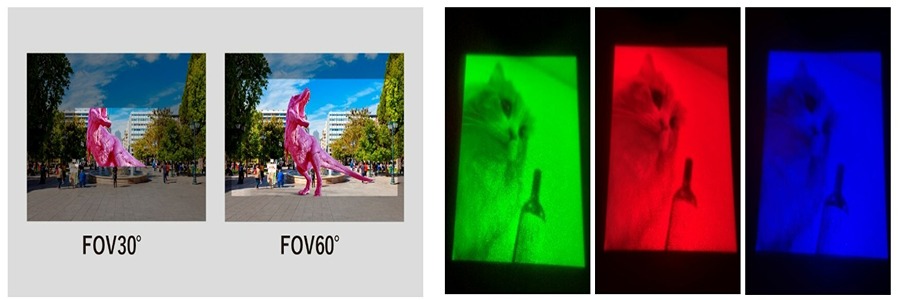
TOKYO, Japan, July 1, 2025 – Cellid has announced the development of a micro projector for AR glasses capable of projecting AR images with a field of view (FOV) of 60°. This was not achievable with mass-produced solutions.
AR glasses are still new, but people are starting to use them for handy tasks like checking notifications, getting weather updates, translations, and using generative AI. Initial growth in this market will likely come from small and lightweight devices. These types can give users benefits, even though their viewing angles are narrower.
The demand for immersive experiences like watching videos, using 3D content, and interacting with physical spaces through spatial computing is set to increase. Because of this trend, people will expect displays to offer wider viewing angles and high-definition display.
To meet these growing developments, Cellid has developed a new micro projector. It features a wide viewing angle, uses light resourcefully, and comes in a compact size. This development improves AR glasses functionality and enables applications to expand from information display to spatial interaction across multiple industries.
Background and Features
Cellid has previously developed waveguide lens for AR glasses supporting a 60° FOV. However, it has remained an industry challenge to develop a micro projector that can project uniform images with a 50° or wider FOV while fitting into the eyeglass-type AR glasses.
Cellid developed a micro projector that offers a wide viewing angle by using its own optical system with a precise barrel design. The parts in micro projectors need careful placement, since even a minor movement can misalign the optical axis. Precise optical alignment is necessary to maintain image clarity and performance in AR displays, especially at wide viewing angles.
Cellid has achieved both optical precision and a wide viewing angle by combining a barrel structure and alignment technology. As a result, Cellid achieves image quality and stable display while maintaining a shape that can be incorporated into a compact eyeglass-type frame.
Key Features of the Newly Developed Wide Micro Projector:
- Compact size (Φ5.8mm x 5.8mm) and light weight (0.3g) to fit normal eyeglass type AR glasses.
- Wide 60° FOV projection, despite its small size, (70° will be supported in 2025).
- Cellid’s precision barrel construction allows selection of the optimum angle of incidence for the waveguide, improving optical performance.
By the end of 2025, Cellid expects to have a stable mass production system. Cellid will focus on improving both optical performance and manufacturing uniformity. The company plans to add products that support FOVs from 50° to 70°.
By jointly developing wide-view micro projectors and waveguides, Cellid improves optical efficiency and AR image quality compared to designing these components separately. Combined with the software correction technology, these advancements are expected to enhance the AR glasses user experience and support the adoption of AR glasses across various industries.
Satoshi Shiraga, CEO, Cellid said: “The successful development of a wide micro projector with a 60° FOV is an important milestone in the development of AR glasses that can be used in a wide range of applications. By combining Cellid’s optical technology and design expertise, we have achieved a wide field of view, high definition, and compact size, which had previously been considered difficult to achieve. We believe that this is not only a technological innovation, but also a significant step toward transforming the AR glasses user experience. We will continue to develop the necessary products and technologies so that more people can use AR glasses in their daily lives.”
Source: Cellid
About Cellid

Cellid Inc., founded in 2003 and based in Tokyo, Japan, develops augmented reality (AR) display modules and spatial recognition engines for AR glasses. The company provides AR-based solutions that use image recognition and deep learning to enable real-time information overlay. Its technology supports applications in consumer electronics, wearable devices, and digital media. Cellid focuses on creating AR optical components, including waveguides and projection systems, for integration into smart glasses and other devices. The company employs around 50 people and reports annual revenue of $22 million. Backed by investors Development Bank of Japan and Tel Venture Capital, Cellid addresses the demand for compact, high-precision AR display technology. Its solutions support manufacturers and developers of next-generation wearable devices for consumer and industrial use.
