

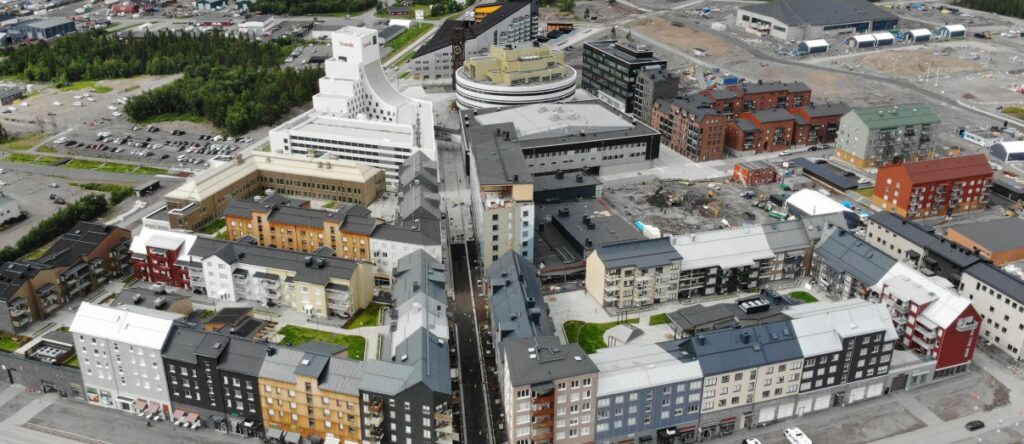
A recent study from the University of Gothenburg reports that Kiruna’s relocated city center now experiences winter conditions up to 10°C colder than its previous site. The original town sat on a south-facing slope with streets following the terrain to maximize sunlight and shelter from wind. By contrast, the new site lies in a low-lying depression where cold air accumulates, and the street-grid and tall buildings restrict sunlight and amplify wind.
Researchers note that the new center features a rigid grid layout, narrow streets, and large open squares, i.e., features that reflect a typical urban design but ignore microclimatic realities of the Arctic. One resident described the shopping-street square as “a bloody wind tunnel.” Design decisions such as playgrounds and balconies facing north-side exposure further indicate that planners did not sufficiently tailor the built environment for the extreme cold.
The article underscores that known architectural strategies for cold-climate cities, such as south-facing slopes, curving streets to deflect wind, and upper floors set back to allow sun to reach open spaces, were omitted in favor of commercial-centric planning. For engineers and designers, Kiruna offers a cautionary tale: relocating or redeveloping in harsh climates demands more than modern materials and dense urban form; it requires microclimate-responsive design. Trees, wind-sheltering structures, optimized solar access, and terrain-aligned street networks are not extras; they’re fundamentals.
In short, Kiruna shows that when urban form meets the Arctic, the margin for design error shrinks. Professionals in architecture, urban engineering, and infrastructure development should keep the following lesson in consideration: climate-adapted design must lead, not follow.
