

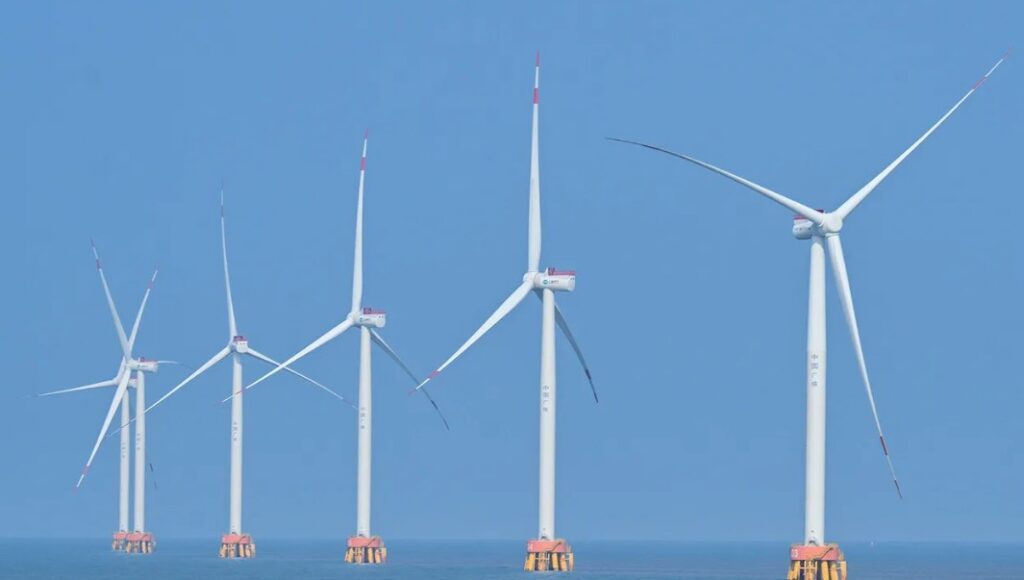
China has installed the world’s largest single-unit floating offshore wind turbine, marking a major step forward in deep-water renewable energy development. The massive 16-megawatt system, called the “Three Gorges Pilot,” was deployed off the coast of Yangjiang in Guangdong Province and is designed to operate in ocean regions too deep for conventional fixed-bottom wind farms, tells Live Science.
Built by China Three Gorges Corporation, the turbine sits atop a semisubmersible floating platform engineered to endure extreme marine conditions. Its rotor spans roughly 827 feet (252 meters), while the blade tip rises more than 886 feet (270 meters) above sea level. Engineers designed the structure to survive waves exceeding 66 feet and wind speeds comparable to a Category 5 hurricane.
Unlike traditional offshore wind systems anchored directly to shallow seabeds, floating turbines can operate farther from shore in deeper waters where wind resources are stronger and more consistent. This dramatically expands the amount of ocean available for clean-energy generation. The project reflects growing global interest in floating offshore wind technology as countries search for alternatives to fossil fuels and seek ways to meet climate targets.
The turbine incorporates several advanced engineering features, including a sophisticated mooring system that combines suction anchors, anchor chains, and high-strength polyester lines to stabilize the platform against waves and ocean currents. It also uses a specialized 66-kilovolt dynamic subsea cable capable of flexing with the movement of the floating structure while transmitting electricity back to shore.
At peak efficiency, the installation is expected to generate approximately 44.65 million kilowatt-hours of electricity annually, enough to power about 4,200 homes. Most of the turbine was assembled on land before being towed offshore for final deployment and testing.
Beyond its scale, the project highlights the broader transformation underway in offshore energy. Floating wind systems are increasingly seen not as experimental prototypes but as viable infrastructure for large-scale clean power generation in regions once considered inaccessible.
