

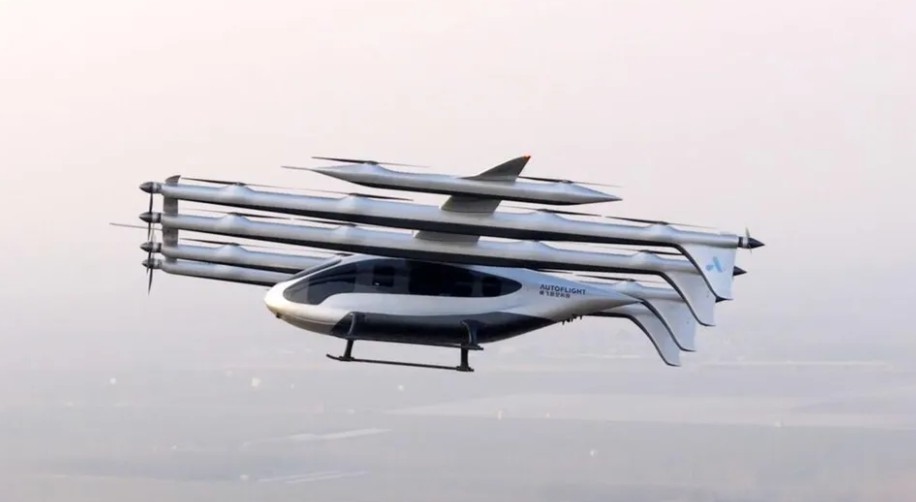
China has taken a significant step in the evolution of electric aviation with the successful test flight of a large, 10-passenger flying taxi, highlighting a shift toward more capable and scalable air mobility systems. Developed by aviation company AutoFlight, the aircraft, known as the V5000, completed its first flight at a dedicated test site in Jiangsu Province, demonstrating stable vertical takeoff, transition to forward flight, and safe landing, tells Live Science.
Unlike earlier electric vertical takeoff and landing (eVTOL) vehicles, which typically carry two to six passengers, the V5000 represents a move toward higher-capacity transport. Weighing around five tons and featuring a wingspan of roughly 20 meters, the aircraft is designed for both passenger and cargo applications. Its passenger variant, sometimes referred to as “Sky Dragon,” can carry up to 10 people, while a cargo version can transport about one ton of goods.
The system uses multiple electric lift motors, around 20 in total, to ensure redundancy and stability, a critical factor for safety in aviation. It also supports hybrid propulsion, enabling a range of approximately 155 miles on electric power alone and significantly longer distances when combined with hybrid systems.
This development reflects a broader shift in the eVTOL industry. While many current designs focus on short urban hops, the V5000 targets regional transport, potentially connecting cities and reducing reliance on traditional ground infrastructure. By processing longer distances and carrying more passengers, it begins to resemble a small aircraft rather than a lightweight drone.
Despite the milestone, commercial deployment remains uncertain. Certification timelines have not been finalized, and regulatory, infrastructure, and safety challenges must still be addressed before widespread adoption.
Still, the successful test flight underscores the rapid progress of China’s low-altitude aviation sector. As designs scale up and capabilities expand, flying taxis are moving closer to becoming a practical component of future transportation networks rather than experimental prototypes.
