

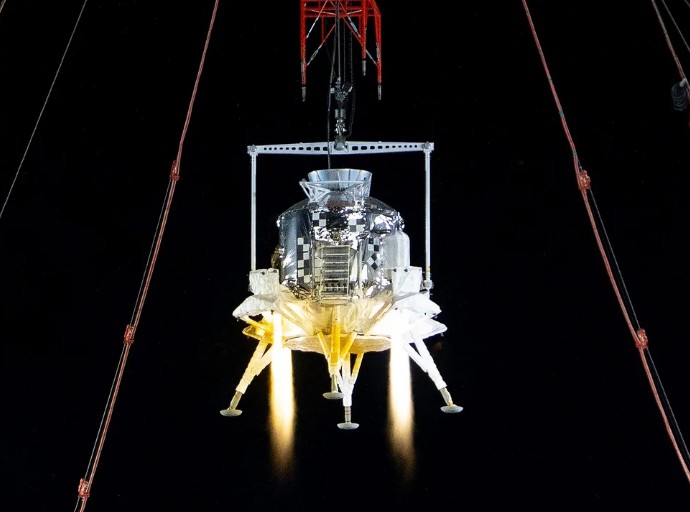
China’s space agency is advancing its lunar program in a way that could place a crewed landing on the Moon around 2030, overlapping the United States’ Artemis timetable, tells IEEE Spectrum. The China Manned Space Agency (CMSA) has developed two key vehicles: a reusable crewed spacecraft called Mengzhou and a lunar lander named Lanyue. Mengzhou, designed to carry up to six or seven astronauts but likely configured for three for a lunar mission, resembles other crewed spacecraft in a blunt-cone profile. It is intended to launch atop a heavy-lift Long March 10 rocket, with a second Long March 10 carrying Lanyue. The plan calls for the two to rendezvous in lunar orbit, transfer crew to the lander, and place two astronauts on the surface while Mengzhou remains in orbit as the return vehicle. Lanyue could also transport a small rover. Initial robotic tests for Mengzhou are expected in 2026, with Lanyue following in 2027, and a first joint test mission targeted for 2028 or 2029. A crewed lunar mission would follow soon after.
China views this effort not as episodic missions but as part of a long-term, integrated space strategy rooted in Project 921, a program launched in the early 1990s that underpins its human spaceflight aspirations. This continuity contrasts with the Artemis program in the United States, which has seen shifting priorities and schedules with changing administrations. Artemis II, NASA’s first crewed lunar mission in decades, is poised for a circumlunar flight, and Artemis III aims for a lunar surface return in the late 2020s. As both programs converge on similar time frames, comparisons between them grow sharper. CMSA officials and analysts note that China’s approach emphasizes incremental development and reuse, aligning hardware and objectives over decades rather than bursts of activity. This could shape global perceptions of space leadership and influence future cooperation or competition in lunar exploration.
