

As countries seek reliable sources of low-carbon electricity to meet growing energy demand, nuclear power is once again attracting global attention. A key debate within the industry centers on whether the future belongs to traditional large reactors or emerging small and microreactor technologies. Recent developments suggest that China is placing a strong bet on large-scale nuclear projects, while the United States is focusing much of its innovation effort on smaller designs, tells MIT Technology Review (full article available to subscribers).
China has nearly doubled its nuclear power capacity since 2016, reaching almost 60 gigawatts. Most of this expansion has come from gigawatt-scale pressurized-water reactors. In contrast, the United States has added only two reactors during the same period, Units 3 and 4 at the Vogtle plant in Georgia, while France connected its first new reactor in more than two decades in late 2024.
The appeal of small reactors lies in their potential to reduce financial risk and construction complexity. Smaller units require less upfront investment and could eventually be manufactured in factories rather than built entirely on-site. The U.S. Department of Energy has encouraged this approach through a pilot program aimed at accelerating reactor development.
One recent milestone came from California-based Antares, whose Mark-0 microreactor achieved criticality, the point at which a self-sustaining nuclear chain reaction occurs. The company plans to develop sodium-cooled microreactors using TRISO fuel and eventually deploy commercial systems by 2028. However, the prototype is still years away from producing electricity.
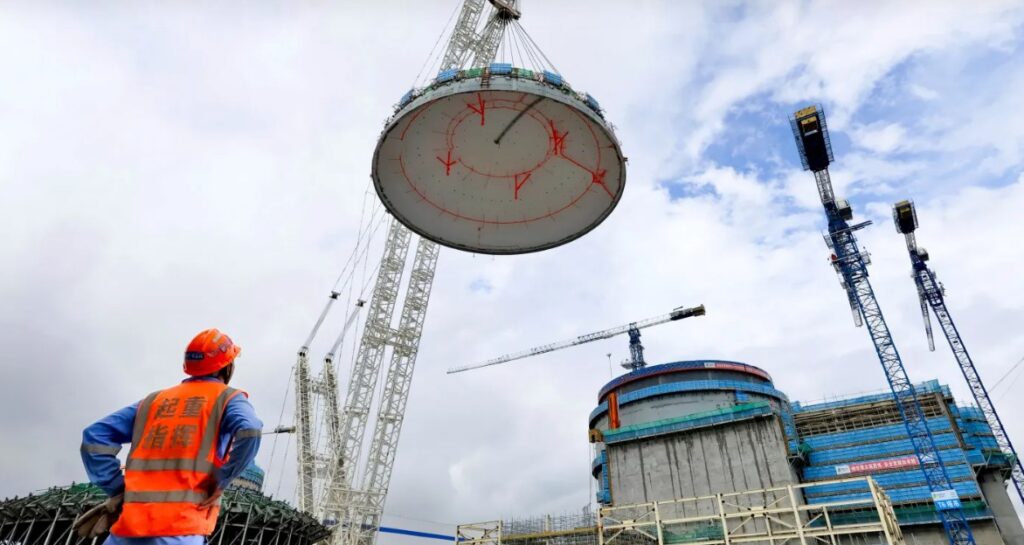
Meanwhile, China continues to demonstrate the advantages of scale. The country began construction on six reactors in 2025 and added two more projects in the first months of 2026. Chinese reactors are typically completed within five to seven years, significantly faster than the global average and far quicker than recent U.S. projects. Standardized designs, batch construction, centralized project management, and strong government support have helped accelerate deployment.
Although China is also developing small modular reactors, including the Linglong-1, its success with large reactors suggests that conventional nuclear plants remain a powerful and economically attractive option for expanding clean electricity generation.
