

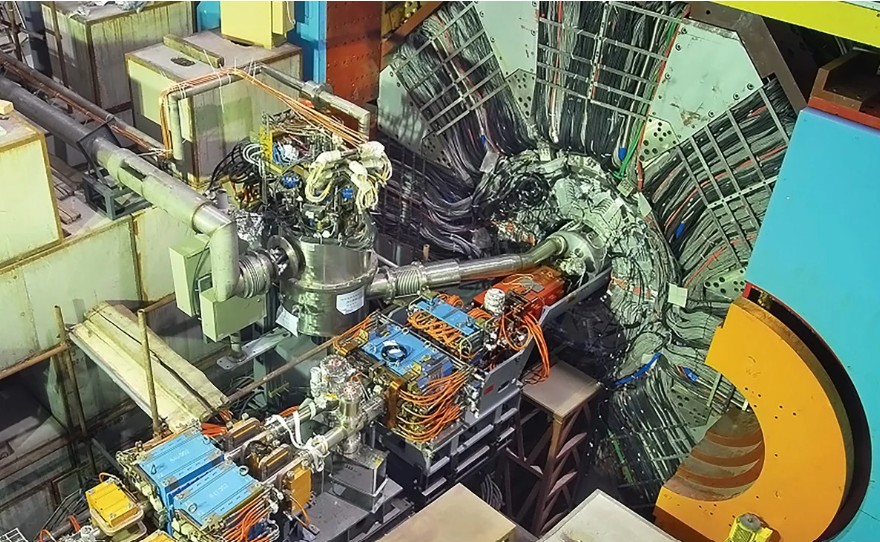
China says it has developed a combined superconducting magnet that outperforms comparable U.S. technology by about 40%, marking an important advance in equipment used for particle physics research. According to Chinese state media cited by the South China Morning Post, the technology has attracted interest from the U.S. Department of Energy’s Brookhaven National Laboratory, which once dominated this specialized field.
The magnet was developed by researchers at the Chinese Academy of Sciences’ Institute of High Energy Physics for the latest upgrade of the Beijing Electron-Positron Collider. The facility is used to study collisions between electrons and their antimatter counterparts, positrons, helping physicists investigate fundamental particles and forces.
Developing the magnet was a long-term effort. Researcher Zhu Yingshun said the team spent 13 years pursuing the technology as part of an effort to reduce dependence on foreign suppliers. The achievement is particularly significant because Brookhaven had previously held a leading position in this class of superconducting magnet technology.
According to the report, Brookhaven contacted the Chinese institute in May 2025 about potentially purchasing the Chinese-made combined superconducting magnet. There is no indication that a purchase has been completed. Chinese researchers have presented the inquiry as evidence that the country has progressed from relying on foreign accelerator technologies to developing equipment competitive with leading international systems.
The magnet is also central to upgrades of China’s collider. Technical information from the Institute of High Energy Physics shows that new superconducting quadrupole magnets were developed to increase the collider’s magnetic field gradient from 18.7 teslas per meter to 25 teslas per meter while maintaining the existing magnet dimensions.
The development highlights China’s growing capabilities in high-energy physics infrastructure. More broadly, it illustrates the increasing importance of domestically developed scientific instruments as countries compete for leadership in particle accelerators and fundamental research.
