

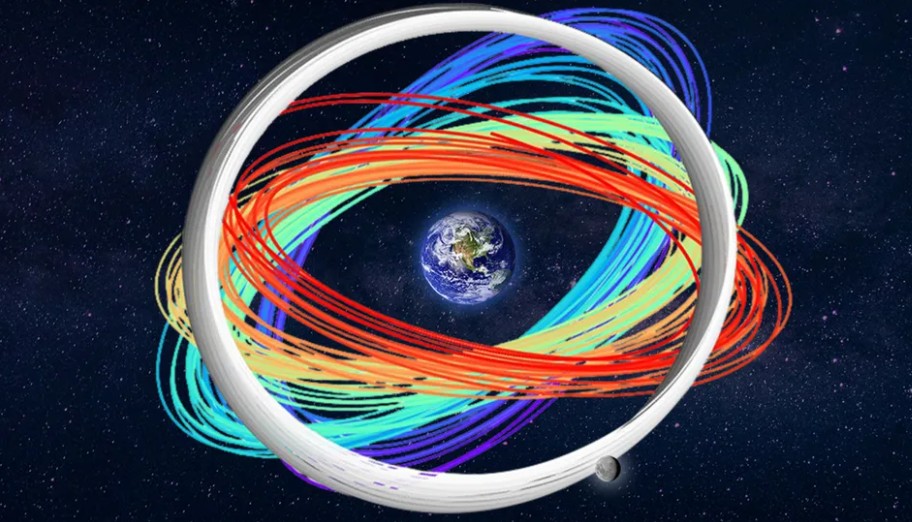
Researchers at the Lawrence Livermore National Laboratory in California used two powerful supercomputers called Quartz and Ruby to simulate the potential orbits of one million satellites placed in cislunar space—the region between Earth and the Moon. The goal was to understand how gravity from Earth, the Moon, and the Sun affects these satellites over long periods, and to map where stable orbits might exist beyond low Earth orbit. The Live Science article tells that the simulations, which took about 1.6 million CPU hours but ran in only three days thanks to parallel processing, showed that fewer than 10% of those hypothetical satellites remained in stable orbits over six years. About 54% stayed stable for at least a year, but only roughly 97,000 of the total maintained orbital stability throughout the entire simulated period.
The findings underscore the complexity of expanding satellite infrastructure beyond Earth’s immediate surroundings. Unlike in low Earth orbit, where paths are more predictable and well understood, cislunar space is shaped by a subtle and shifting gravitational tug-of-war among Earth, the Moon, and the Sun. Small variations, even uneven gravity caused by the Earth’s nonuniform shape, affect trajectories, making long-term orbit prediction computationally intensive and uncertain.
This research has practical implications as governments and private firms explore placing communications networks, navigation systems, and lunar support infrastructure between Earth and the Moon. While less than 10% of simulated satellites survived long enough to be useful, the 97,000 stable trajectories still identified could serve as a starting point for future mission planning. Moreover, publishing the full dataset of simulated orbits in an open-source format allows other scientists and engineers to analyze orbital behavior, refine predictions, and explore machine-learning approaches to classify orbit lifetimes and stability patterns.
In short, long-term orbital stability in cislunar space is rare and fragile, but mapping it with supercomputers opens a window into future exploration and satellite design beyond Earth’s immediate orbit.
