

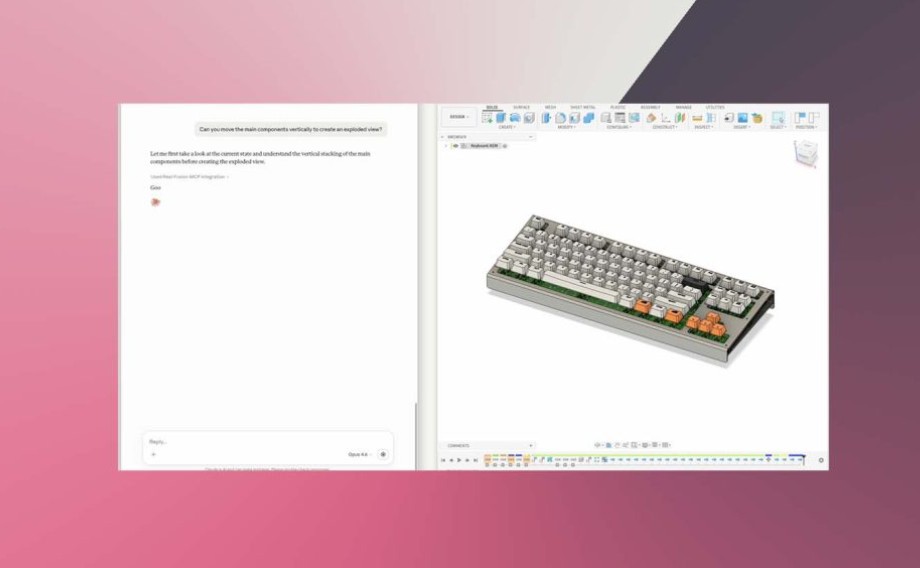
Anthropic’s latest move brings its Claude AI model directly into professional design environments, signaling a shift from conversational assistance to embedded engineering workflows. The Develop 3D article outlines how new Model Context Protocol (MCP) connectors allow Claude to operate inside tools such as Blender and Autodesk Fusion, bridging the gap between idea generation and executable design.
In Autodesk Fusion, the integration introduces a form of text-to-CAD interaction. Designers can describe intent in natural language and have those instructions translated into geometry, enabling faster progression from concept to manufacturable output. Routine modeling steps can be automated, reducing manual effort while maintaining the structured, constraint-driven nature of CAD systems. Importantly, users retain control over data access and execution, aligning with Autodesk’s established security and privacy standards.
The Blender connector takes a different approach, leveraging the platform’s Python API to give Claude a language-based interface to scripting. This allows the AI to analyze entire scenes, detect errors, and generate custom tools that integrate directly into the software. Tasks such as batch-editing objects, assigning materials, or debugging complex scenes can be handled through conversational input, expanding what users can accomplish without deep scripting expertise.
A key element underpinning both integrations is the MCP framework, which enables AI systems to access software environments securely while remaining interoperable. Because MCP is not limited to Claude, it reflects a broader push toward open ecosystems where multiple AI models can interact with design tools.
The initiative also aligns with wider industry efforts to embed AI within engineering software, as seen in Autodesk’s own AI assistant strategy. Together, these developments suggest a future where design workflows become increasingly conversational, automated, and interconnected.
While still early, the integration marks a meaningful step toward AI systems that do more than suggest ideas, actively participating in the creation and manipulation of complex engineering data.
