

BURLINGTON, MA, Nov 19, 2025 – COMSOL released COMSOL Multiphysics version 6.4 with new features, performance improvements for multiphysics modeling and simulation app development. The latest version improves solver performance using the NVIDIA CUDA direct sparse solver, NVIDIA cuDSS for AI systems. It also adds a Granular Flow Module and a new dynamic analysis framework.
The release also updates geometry, meshing and visualization workflows in COMSOL Multiphysics. Users can optionally enable large language model (LLM)–assisted simulation to improve productivity. The new chatbot window connects to GPT-5, DeepSeek, Google Gemini, Anthropic Claude and other compatible models. It provides interactive assistance that combines COMSOL documentation with information from the active simulation.
“Our goal with every release of COMSOL Multiphysics is to enhance the user experience and make it easier to achieve faster, more accurate modeling and simulation results,” said Bjorn Sjodin, SVP of product management at COMSOL. “With added support for GPU-based solvers, the new Granular Flow Module, and explicit structural dynamics capabilities, we’re looking forward to seeing how users apply the platform to improve product designs and innovate. I’m particularly excited to see how GPU acceleration will speed up compiled simulation apps.”
Faster Simulations with GPU-Accelerated Solvers
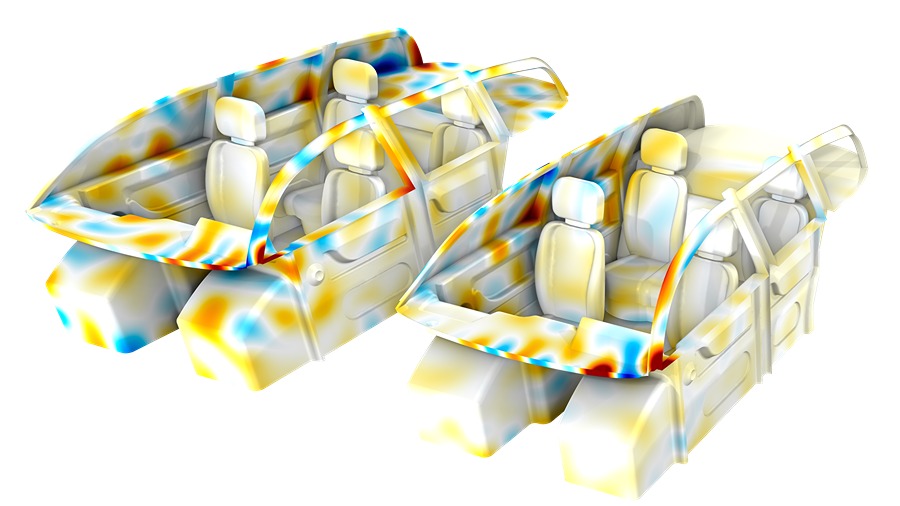
Version 6.4 of COMSOL Multiphysics introduces NVIDIA GPU acceleration for direct solvers and expands multi-GPU support for acoustics simulations. The update continues COMSOL’s work to improve solver performance and scalability.
cuDSS supports all NVIDIA GPU architectures and can deliver substantial speed gains compared to CPU-based direct solvers, depending on the hardware and model. GPU acceleration benefits single-physics and multiphysics simulations, especially when solver robustness matters.
“The integration of cuDSS into COMSOL Multiphysics marks a critical step in bringing accelerated computing to the heart of engineering simulation,” said Tim Costa, general manager of industrial engineering at NVIDIA. “Engineers can now explore larger design space with greater fidelity, reshaping how industries design, validate, and optimize the products that power our world.”
Additionally, NVIDIA CUDA-X cuBLAS library is accelerating the GPU formulation for transient pressure acoustics simulations which can run on multiple GPUs on the same machine, or on a GPU cluster. These improvements reduce computation time for larger models.
New Product for Simulating Motion and Interactions of Solid Particles in Bulk Processes
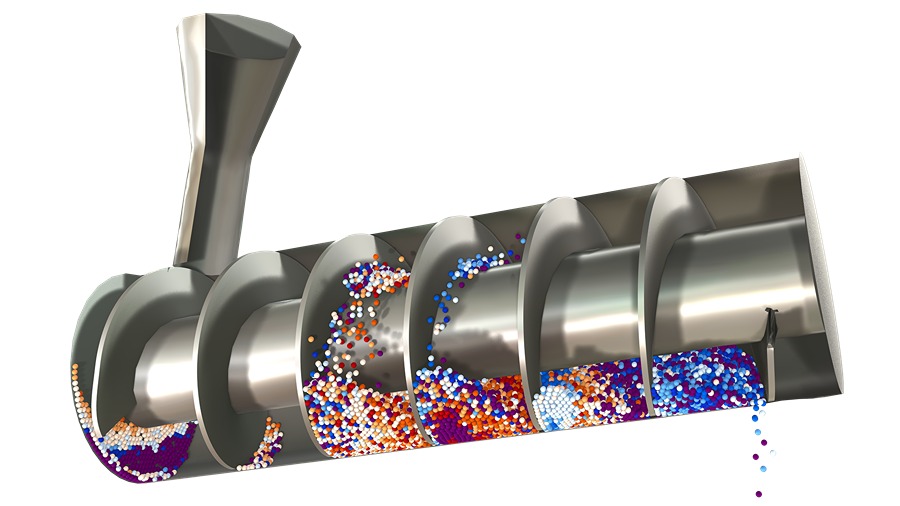
The Granular Flow Module lets engineers model granular processes such as hopper discharge, silo storage, chute transport, powder spreading and mixing. The Granular Flow Module supports applications in pharmaceuticals, chemical processing, agriculture, mining and additive manufacturing.
The module captures particle-scale effects, including collisions, adhesion and rotational resistance. It also provides controls for grain properties, release conditions and wall interactions. These tools help users evaluate flow uniformity, packing density, mixing efficiency and wall stresses, and identify issues such as blockages to support process design.
More Efficient Simulation for Time-Explicit Dynamic Analysis
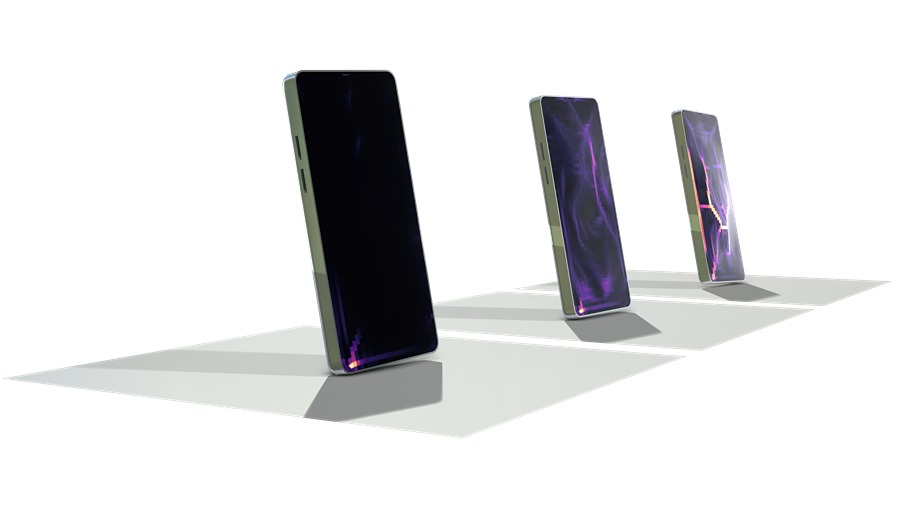
Version 6.4 introduces a time-explicit analysis framework for fast, transient and nonlinear events such as impact, crushing and elastic wave propagation. The method supports nonlinear structural materials, including hyperelastic, plastic, viscoplastic and creep models, and works with dynamic fracture simulations. New function also detect and define contact conditions between interacting parts to simplify model setup for mechanical assemblies.
News Across the Product Suite
Additional highlights of COMSOL Multiphysics(V6.4) include:
- Higher-quality quad-dominant meshing and swept meshing
- Spatially varying transparency
- Array-based plot layouts
- Efficient building of large simulation apps
- Optimization options for time-dependent and parametric studies
- Export of network parameters for deep neural network (DNN) surrogate models
- Surrogate model data generation on clusters
- Import of CFD data in CGNS format
- Frequency- and time-dependent uncertainty quantification
Source: COMSOL
About COMSOL

COMSOL develops software for engineering simulation and multiphysics modeling used by technical enterprises, research labs and universities. Its main product, COMSOL Multiphysics, provides an environment for building physics-based models and simulation apps and supports coupled, or multiphysics, behavior. Add-on modules extend the platform for electromagnetics, structural mechanics, acoustics, fluid flow, heat transfer and chemical simulations. The company also offers tools that connect its simulations with CAD and technical computing software used across the CAE market. Users can deploy simulation applications through COMSOL Compiler and COMSOL Server, which support teams in design, manufacturing and testing. COMSOL was founded in 1986 and is headquartered in Stockholm, Sweden. The company operates 16 offices worldwide and works with a global distributor network. It serves hundreds of customers across industries and employs more than 500 people.
