

MIT researchers have enhanced a concrete-based energy storage technology, called ec³ (electron-conducting carbon concrete), achieving about 10 times more energy density than earlier versions, tells MIT News. Their improvements bring the idea closer to reality: structures such as walls, slabs, and bridges could one day not just support loads, but also store and deliver electricity.
The innovation rests on embedding a network of nanoscale carbon black particles throughout the concrete, forming a conductive “web” that lets ions and electrons move through it. The team improved both this nanonetwork’s geometry and the electrolyte formulation. By casting thicker electrodes with electrolyte integrated into the mixing phase, the new version pushes a cubic meter of ec³ to store over 2 kWh, enough to power a refrigerator for a day.
In previous iterations, energy storage was limited: powering the daily energy needs of a typical home demanded about 45 m³ of ec³. With the new design, that drops to just around 5 m³, roughly the volume of a basement wall. That’s a big leap toward making this more than a lab curiosity.
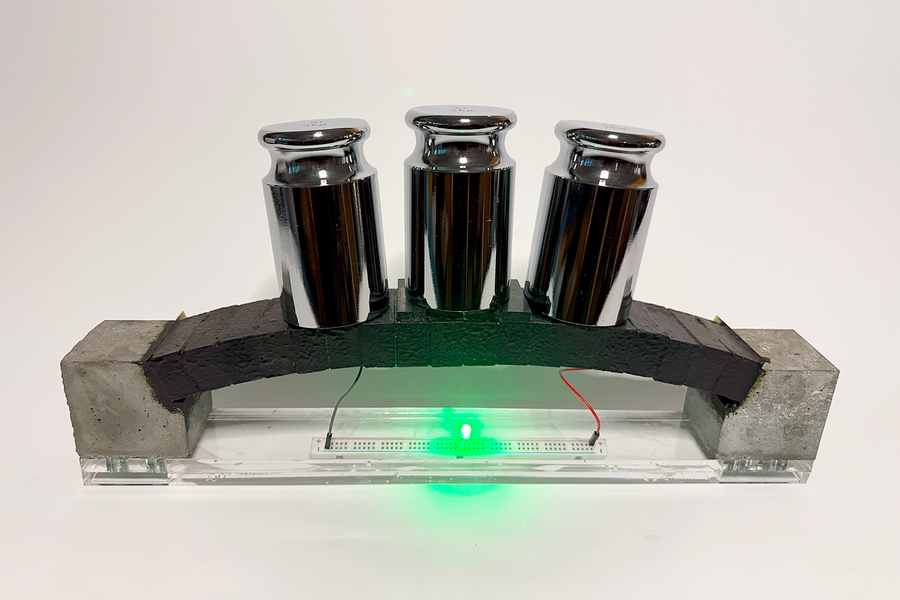
The researchers demonstrated prototypes too: one concrete arch both supported mechanical load and powered an LED. Interestingly, as the structural load varied, the light flickered, suggesting ec³ might also serve as a self-monitoring structural health sensor. Because stress changes could distort internal electrical connectivity, fluctuations in power output might hint at damage or strain.
Challenges remain. Batteries still outperform ec³ in raw energy density. Yet the appeal of embedding storage right into the built environment is strong. The team foresees ec³ in roads that charge electric vehicles, walls that store rooftop solar power, or buildings that operate off-grid.
By weaving energy storage into a material as ancient and ubiquitous as concrete, MIT’s work points toward a future where infrastructure does more than stand, it powers.
