

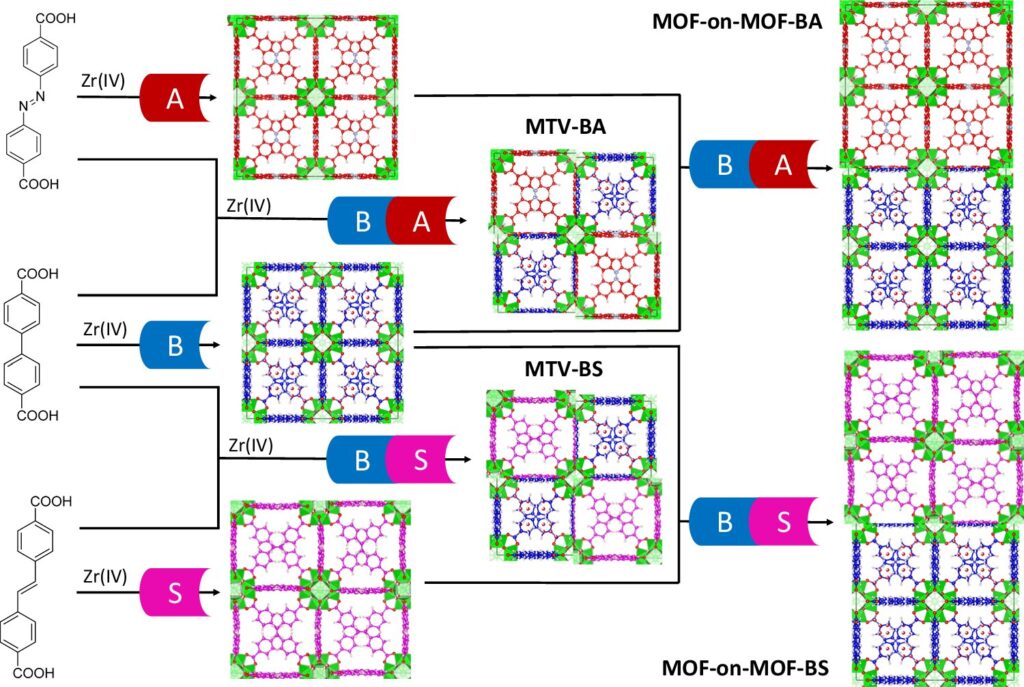
Scientists from Oregon State University report a metal-organic framework approach that could cut the power needed for lighting and display devices. The idea is simple in concept. Put two different metal-organic frameworks (MOFs) together in a core-shell stack so that the emitters are close enough to harvest energy efficiently but far enough apart to avoid quenching. That structure boosts light output for the same electrical input, tells Tech Xplore.
The group compared two heterostructure strategies. Multivariate MOFs mix multiple ligands within one lattice. MOF-on-MOF grows one MOF on top of another. Using UiO-67 as the core and Zr-AzoBDC or Zr-StilBDC as shells, the MOF-on-MOF design reached a quantum yield up to 40%, roughly four times higher than single-ligand baselines and far above comparable multivariate mixes at about 10%. Higher quantum yield means more photons per joule, which directly lowers the wall-plug power needed for a target luminance.
Why does this conserve energy at scale? Displays and lighting account for a large share of electricity use, so improving emitter efficiency trims both operating energy and waste heat across billions of devices. By raising radiative efficiency inside the phosphor layer, downstream optics and drivers can be sized for lower power while meeting the same brightness and color points.
There is also a material win. Today’s bright emitters often rely on rare-earth dopants like europium or terbium. Mining and refining them is costly and environmentally intensive. The MOF heterostructures demonstrated here rely on ligand-centered emission and zirconium frameworks, which points to rare-earth-lean or rare-earth-free stacks. That reduces embodied impacts in the supply chain while maintaining high optical performance.
To sum it up, by decoupling emitters through a core-shell MOF architecture, the work opens a path to brighter pixels and lamps at lower power, with less dependence on rare earths. Next steps are device integration and lifetime testing, but the physics result is strong and has been published as open access.
