

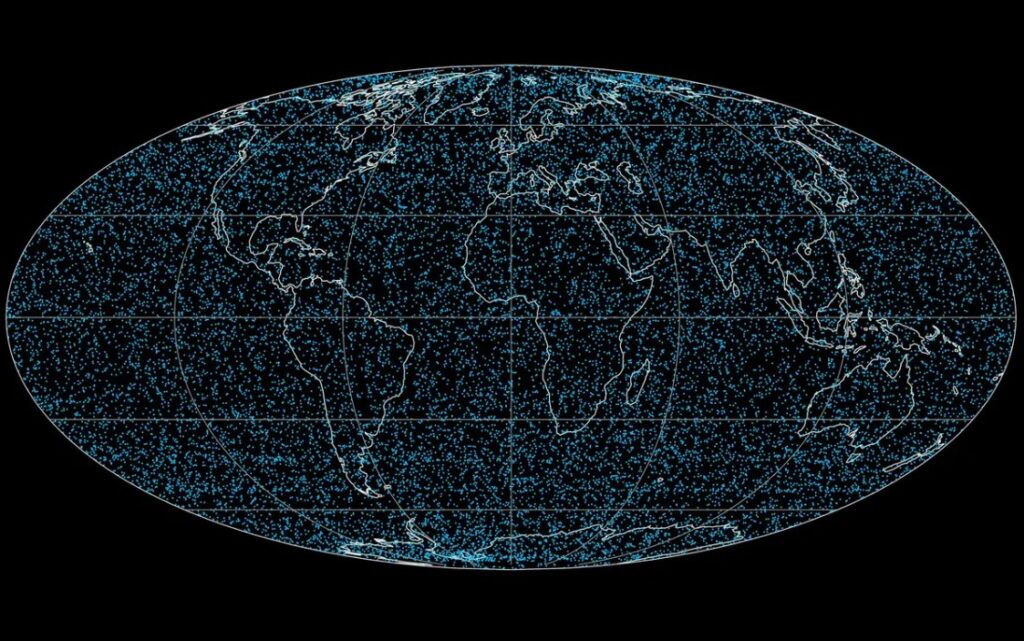
A recent IEEE Spectrum article examines what researchers call the “CRASH Clock,” an indicator of how quickly satellites in low Earth orbit (LEO) could begin colliding if all maneuvering ceased; for example, after a major solar storm or systemwide failure. This metric does not predict a full runaway cascade like the theoretical Kessler syndrome but rather reflects how dependent current space infrastructure is on perfect operations every day. In a worst-case scenario where satellites can’t move to avoid one another, the first collision could occur within days, showing just how constrained orbital space has become.
The CRASH Clock concept comes from an arXiv preprint by a team including astrophysics and astronomy researchers. It measures how much time would pass before a catastrophic collision if no collision-avoidance maneuvers were possible. The short time frames suggested by the metric, on the order of a few days, aren’t meant as a literal countdown but as a barometer of orbital stress. As the number of satellites and debris in LEO has risen sharply with megaconstellations such as Starlink and others, the space environment’s tolerance for error has shrunk.
Experts interviewed for the article stress that this isn’t an immediate apocalypse for space operations or a sudden Kessler syndrome event. The classical Kessler syndrome refers to a cascading chain reaction of collisions that exponentially increases debris, potentially making orbit unusable over long periods. That scenario, first proposed by NASA scientists in the 1970s, would take decades to develop and relies on sustained high debris densities and collision rates.
Instead, the CRASH Clock points to today’s operational reality: Earth orbit is crowded, and satellite operators depend on continuous collision avoidance. Should that capability be lost, through a solar storm, technical failure, or systemic outage, the first crash could occur in a matter of days. Such a collision would create more debris and escalate risk, underscoring the importance of improved space traffic management, debris mitigation, and coordinated international action to preserve orbital safety.
