

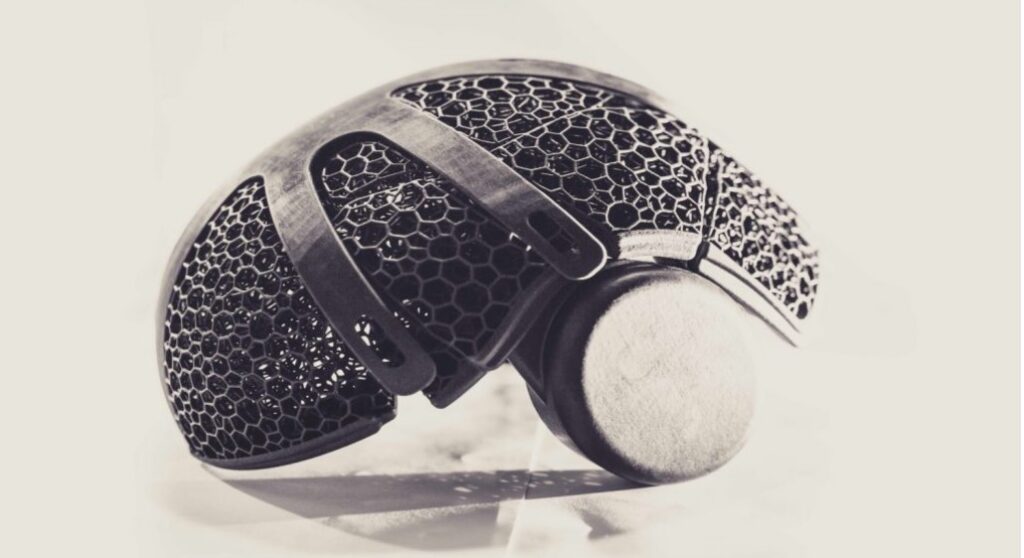
A growing number of manufacturers are using additive manufacturing and digital scanning technologies to rethink one of the most standardized forms of personal protective equipment: the helmet. The article from Develop 3D explores how 3D printing is enabling custom-fit helmet designs that move beyond traditional foam liners and fixed-size shells toward highly personalized protection systems shaped around the geometry of individual users.
The article explains that conventional helmets rely on generalized sizing models that attempt to accommodate large populations using a limited range of shell sizes and padding adjustments. While effective at meeting safety regulations, these designs often create compromises in comfort, weight distribution, ventilation, and impact management. Engineers and manufacturers are increasingly turning to digital workflows that combine head scanning, computational modeling, and additive manufacturing to address these limitations.
One key advantage of 3D printing is the ability to create lattice structures with precisely tuned mechanical properties. Instead of relying entirely on uniform foam layers, designers can engineer internal geometries that vary in density, flexibility, and energy absorption across different regions of the helmet. This allows protection systems to respond more intelligently to different impact conditions while reducing unnecessary bulk. The article notes that these lattice structures can also improve airflow and long-term comfort for users in sports, industrial, and military applications.
The workflow typically begins with a high-resolution scan of the wearer’s head, generating a digital model that forms the basis for a customized fit. Advanced software tools then optimize the internal geometry before the components are produced through additive manufacturing processes. According to the article, this level of personalization was previously impractical using conventional manufacturing techniques because molds and tooling costs made individualized production economically difficult.
The article also highlights the broader industrial implications of this shift. Additive manufacturing enables rapid iteration, localized production, and reduced inventory requirements because products can be manufactured on demand rather than mass-produced in fixed configurations. As material science and computational design continue advancing, helmet development may increasingly move toward data-driven protective systems tailored not only to anatomy but also to specific user activities and environmental risks.
Rather than treating protection as a one-size-fits-all product category, the article presents 3D printing as a pathway toward individualized safety engineering shaped by digital manufacturing precision.
