

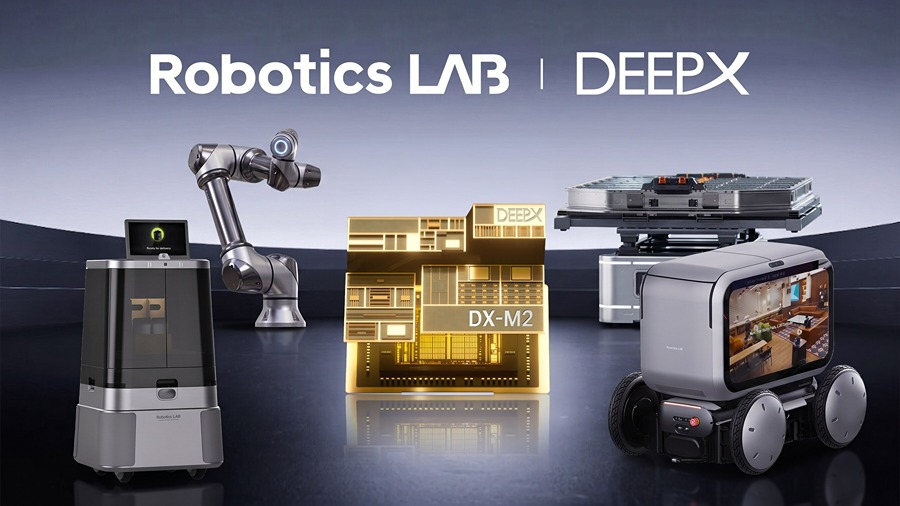
SEOUL, South Korea, Apr 22, 2026 – DEEPX and Hyundai Motor Group Robotics LAB are co-developing a physical AI computing architecture for robotics that runs large-scale generative AI models in real time within robotic systems. The architecture targets applications where robots process visual input, interpret language, and execute actions in operational environments.
The partnership centers on Vision-Language-Action (VLA) and Vision-Language Model (VLM) workloads, combining camera data processing, natural language interpretation, and decision-making. These models support robotic systems with integrated perception and control functions.
To support deployment in real-world environments, the companies are developing the computing stack across the following areas:
- Ultra-low-power AI semiconductor architecture
- AI computing hardware systems for robotics
- Physical AI software stack
- Robotics application AI libraries
The architecture is designed to execute AI models in real time within robotic platforms.
At the core is the DX-M2 AI chip, designed for low-power execution of large-scale models. The chip supports on-device inference for robotics, autonomous mobile systems, and industrial automation, allowing devices to process data locally without relying on external compute resources.
The collaboration builds on three years of joint development of edge computing systems for robotics based on low-power AI semiconductors, including “edge brain” technology. The current work extends these systems to support generative AI workloads and integrated computing functions.
The work reflects a shift toward physical AI, where compute moves from data centers into robots and industrial equipment. The physical AI semiconductor market is projected to reach about $123 billion by 2030, with robotics and humanoid systems expected to drive demand. Standardized computing architectures are expected to support scaling across robotics platforms.
Lokwon Kim, CEO, DEEPX said: “The AI industry is rapidly shifting from data center-centric models to a Physical AI era, where intelligence expands into real-world systems. The next five years will be decisive in reshaping the industry. In the Physical AI era, ultra-low-power computing technology capable of running AI in real-world systems – robots, vehicles, industrial devices – will become the core infrastructure. DEEPX aims to become the global leader in Physical AI computing platforms that power AI across robotics and industrial systems.”
Dong Jin Hyun, vice president, head of Robotics LAB at Hyundai Motor Group added: “In the era of Physical AI, robots are becoming the closest point of contact between AI technology and people. At Hyundai Motor Group Robotics LAB, our goal is to create robots that can naturally coexist with humans – robots worth living with and working with. To achieve this, we are strategically building a core technology ecosystem – including on-device AI computing – in collaboration with specialized partners across industries worldwide.”
Source: DEEPX
About DEEPX

DEEPX develops AI chips and software for on-device computing. Its products include neural processing units and modules that process data within devices without cloud dependence. The company provides hardware, development tools, and integration support for AI-enabled systems. Its technology supports robotics, smart cameras, industrial automation, and autonomous systems. DEEPX serves customers in robotics, automotive, consumer electronics, surveillance, and manufacturing industries. The company was founded in 2018 by Lokwon Kim. It is headquartered in Seongnam, South Korea. The company employs about 65 people worldwide.
About Hyundai Motor Group

Hyundai Motor Group is a global automaker that produces cars, electric vehicles, and mobility solutions for markets worldwide. Formed in 1998 after acquiring Kia Motors, the group operates across multiple industries, including automotive, mobility, finance, logistics, and steel and construction. Hyundai Motor Group employes approx. 315,000 people worldwide. Headquartered in Seoul, South Korea, the company maintains manufacturing plants, research centers, and sales networks around the world.
