

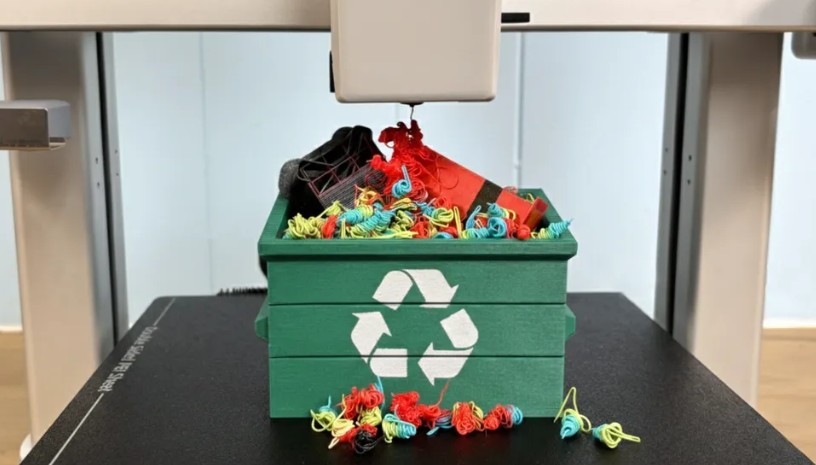
Additive manufacturing has grown far beyond niche workshops and now sits on the desks of hobbyists, creators, and small prototyping labs. That rise in accessibility has a downside: 3D printing waste. Failed prints, discarded prototypes, and excess support structures pile up quickly, and unlike industrial plastics, most hobbyist filaments aren’t labeled with resin codes that recycling centers can process. As a result, these scraps often end up in landfills, even though common filaments such as PLA and PETG are technically recyclable. Municipal recycling systems typically reject such material because they can’t identify or sort it properly, and contamination from mixed plastics can make what should be recyclable worthless.
Tom’s Hardware says one proposed solution is desktop filament recycling, that is, machines that let users grind and re-extrude discarded prints into fresh filament for reuse. For years, this idea existed mainly in DIY and hobbyist circles, with projects built from old parts or wood. Now, more polished options are emerging. Creality announced the Filament Maker M1 paired with the Shredder R1, a two-part system that processes scraps into new filament with tolerances suitable for most hobby 3D printers. Another approach, LOOP, combines grinding and extrusion in a single unit with claimed high precision, though production delays have pushed its availability into 2026. DIY kits such as ExtrudeX and modular extrusion systems such as Felfil Evo offer lower-cost entry points but still require hands-on calibration and material preparation.
Despite these advances, desktop recycling isn’t yet a practical replacement for industrial systems. Professional extrusion lines cost tens of thousands of dollars, and even with desktop machines, users must sort, clean, and grind plastic before processing. Heavy users and makerspaces stand to benefit first, but widespread adoption will depend on cheaper, easier‐to-use machines. If that happens, the filament once destined for the trash could be spun into new spools, cutting waste and material costs at the same time.
