

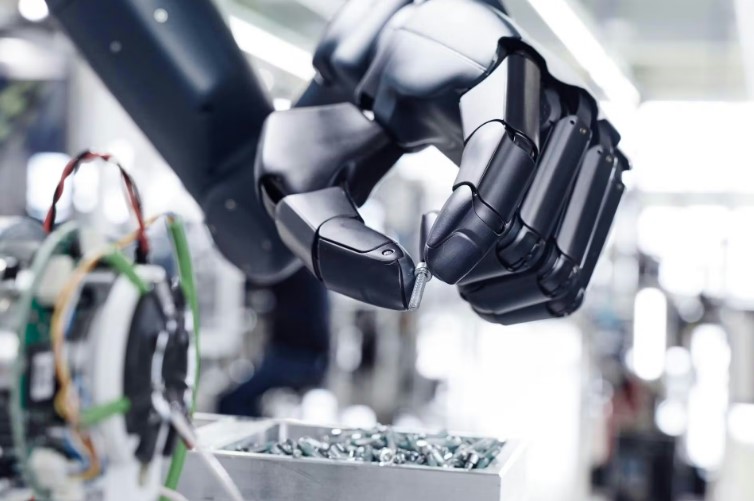
Robotic hands are increasingly designed to mirror one of the most sophisticated capabilities of the human body: translating neural intent into coordinated, precise motion. The article from Machine Design explores this shift through Agile Robots’ approach, focusing on how advanced end effectors are redefining robotic interaction with the physical world.
Human hands serve as a bridge between cognition and action, enabling grasping, sensing, and manipulation. Robotics seeks to replicate this by enhancing the “end effector,” the component that directly engages with objects. Unlike traditional grippers built for repetitive, predefined tasks, modern robotic hands must handle variability, adapt to different objects, and operate with both strength and delicacy.
Agile Robots’ “Agile Hand” reflects this evolution. Designed with five modular fingers, 21 joints, and up to 16 degrees of freedom, it closely mimics the kinematics of a human hand. Despite weighing around 1.5 kg, it can exert fingertip forces of about 10 newtons, allowing it to perform both firm and sensitive manipulations.
Beyond mechanical design, the real advancement lies in integrating perception and control. Inspired by the human sensorimotor loop, robotic systems now combine visual, tactile, and other sensory inputs to interpret their surroundings. These inputs are processed through AI systems that convert environmental data into precise movements, effectively translating “digital intent” into physical action.
This capability is critical for modern manufacturing, where robots must shift from rigid automation to flexible, adaptive operation. Tasks such as handling delicate components, assembling complex products, or working in unstructured environments demand a level of dexterity that only advanced robotic hands can provide.
The broader implication is a transition toward general-purpose robotic manipulation. As sensing, control, and mechanical design converge, robotic hands are moving beyond specialized tools toward systems that can interpret context, adjust in real time, and execute nuanced actions. This marks a significant step toward robots that operate with a level of precision and adaptability once reserved for human hands.
